
Photo credit: Richard Hubert Smith
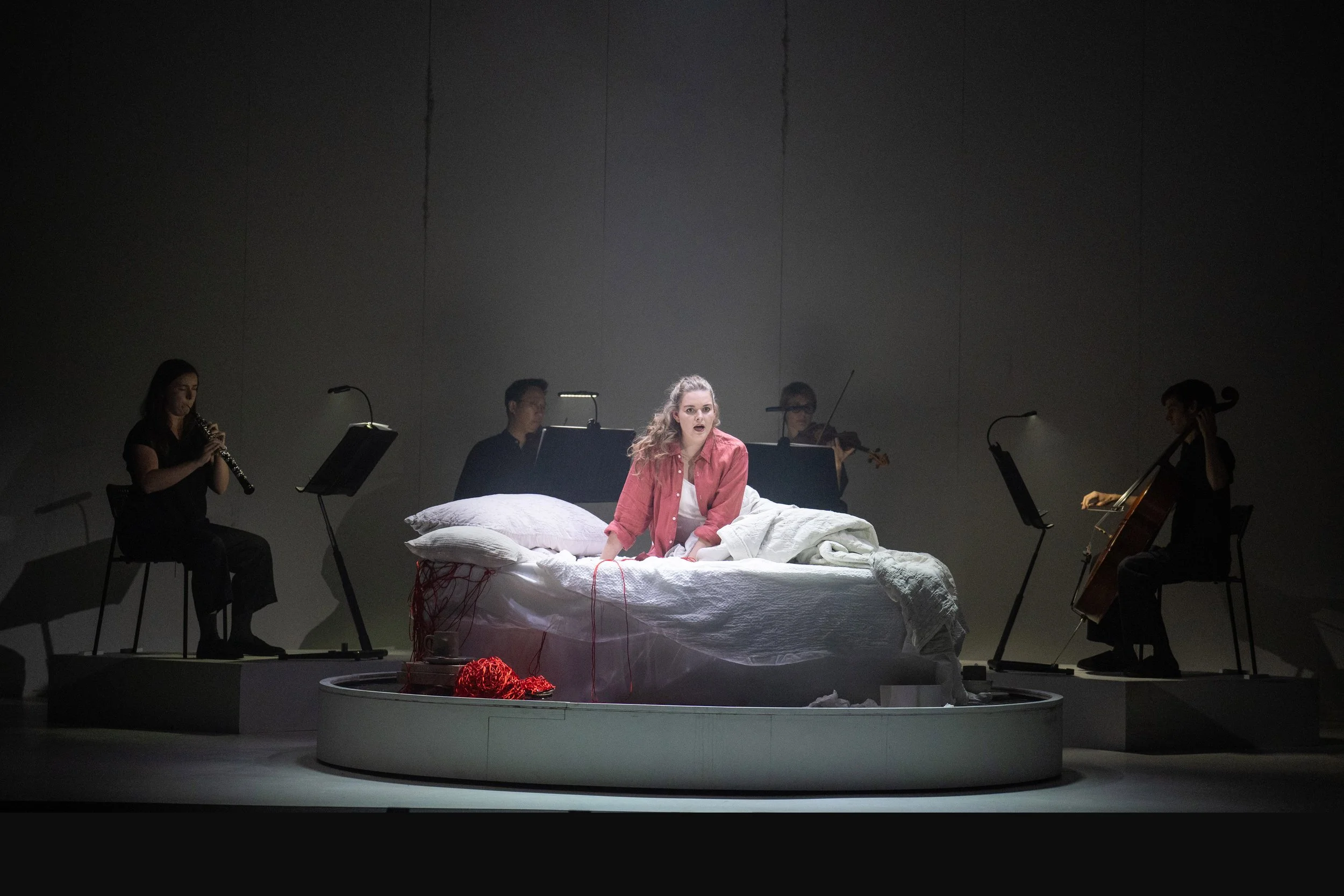
Photo credit: Richard Hubert Smith
Double Bill: Elena Langer’s Ariadne; Henry Purcell’s Dido & Aeneas;
English Touring Opera
⭐⭐⭐⭐ Review of Clare Colvin
“A perfect Die Aria.”
There is a clear link in the two mythological subjects that make up the double bill of the English Touring Opera this autumn. Both of the women wake to find they have been deserted by their lovers. Nor had their legendary Greek heroes stayed to explain themselves. Ariadne wakes on the island of Naxos to find the bed empty of Theseus, who has left without saying goodbye, despite that she had rescued him from certain death in the Minotaur’s labyrinth, using a ball of string, and had deserted her Cretan family to follow him. Meanwhile, Queen Dido of Carthage, after a loving night with the Greek hero of the Trojan wars Aeneas, only wakes the following morning to see his ship leaving the harbour. The betrayal gives rise to one of the most exquisite laments that Purcell ever wrote, “Remember me . . . but O forget my fate.”
The 20-minute length chamber opera of composer Eleanor Langer’s Ariadne, first performed in 2002, has soprano Jessica Cale’s Ariadne raging at Kieron-Connor Valentine’s absent Theseus. A quartet of musicians playing violin, viola, cello, and oboe, surround the abandoned woman, as she protests her fate - in fact things don’t turn out too badly for her, as Dionysus, God of wine, steps in to comfort her. Directed by Anna Morrissey, it is about long enough to earn its place as a makeweight for the evening, and Glyn Maxwell contributes to the words of the libretto.
Dido & Aeneas has very much more of a baroque operatic plot, with a villain. Purcell creates a set of three witches and a spirit imp, with a pronounced malice towards Queen Dido - the imp persuading Aeneas that the soldier is needed back in Italy in the aftermath of the Trojan war to create a new Roman branch. Directed by Rebecca Meltzer, and with Conductor Alex Robinson at the Harpsichord, ETO returns to the baroque, which has in the past been a favourite musical range. Samantha Price brings out the underlying tensions that foreshadow the fate of the unhappy Queen and sings the perfect Dido’s lament to Isabelle Atkinson’s waiting lady Belinda. Purcell’s only true opera was given one of its earliest performances in 1689 at Josias Priest’s school for girls in Chelsea. One wonders whether its audience took note about the reliability of Greek heroes.
Info: englishtouringopera.org.uk : Queen’s Theatre, Barnstaple, 2nd November; Malvern Festival Theatre, Sat 14 November; Saffron Hall, Sat 21 November
For Ariadne:
Director: Anna Morrissey
Conductor/Harpsichord: Alex Robinson
Musical Preparation: Claudia Fuller
Set & Costume Designer: Alex Berry
Lighting Designer: Joseph Hornsby
Costume Supervisor: Beth Qualter Buncall
For Dido & Aeneas:
Director: Rebecca Meltzer
Conductor/Harpsichord: Alex Robinson
Set & Costume: Alex Berry
Lighting Designer: Joseph Hornsby
Fight Director: Haruka Kuroda
Production pictures: Richard Hubert Smith