Harvest (2025), Dir Athina Rachel Tsangari, Mubi, Mac Birmingham, 3☆☆☆. Review: Matthew Alicoon.
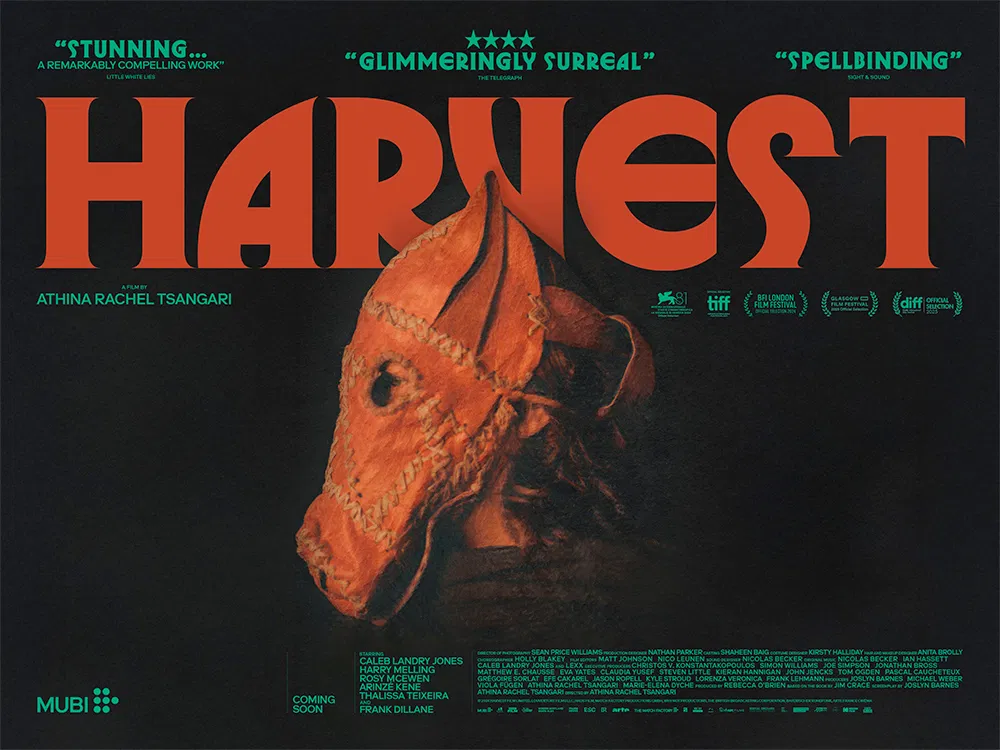
Harvest (2025), Dir Athina Rachel Tsangari, Mubi, Mac Birmingham,
3☆☆☆. Review: Matthew Alicoon.
Cinema – Drama – History – Period
“Exclusion speaks louder than words in this understated drama.”
Running Time: 133 Minutes
Harvest takes place in a remote English village where suspicion is raised over the arrival of three outsiders. What begins as a subtle observation of suspicion gradually becomes something more unsettling: a portrait of a community unravelling and decaying.
Based on Jim Grace’s 2013 Novel entitled “Harvest”, the film resonates as a timely and deeply spoken piece on segregation. Athina Rachel Tsangari and Joslyn Barnes’ screenplay is a carefully articulated amalgamation of exclusion and belonging, acting as a resourceful insight into what perceptions each member of the village holds. There is a tactile approach towards particular moments, as dialogue is sparse, yet the emotional turmoil is palpable. The absence of speech engulfed the screen with crippling anxiety and dread, as there is an architectural craft of unease through body language and facial mannerisms. There was a scene involving a haircut that conveyed significant tightness and it challenges you as a viewer to interrogate the room of what the characters are thinking. Sean Price Williams’ cinematography is fundamental throughout, as the pristine feel to the village takes on an active presence which is inhabited stunningly in the film.
Caleb Landry Jones plays the lead of Walter Thirsk. Jones is incredibly hypnotic and internalised, crafting an impeccable enigma around his character. There is an occupation of identity crisis with a confliction of complicity and detachments. A number of times Caleb Landry Jones stands in the background of scenes. However, his mannerisms make his performance linger. Rosy McEwen provides an undeniable charm and charisma to her role as Kitty Goose. Harry Melling strongly conveys the state of confusion as Charles Kent and brings a brilliant underlying lack of masculinity. Frank Dillane charms as a menacing arrogant cousin (Charles’ cousin) and never overplays it, making the precision more effective. Harvest is a film that excels when it is about how events can unnerve and startle its individuals.
Where Harvest begins to faulter is in its second half, as the film outreaches itself to be a focus on the collective rather than the individuality of characters. In attempting to capture the broader social breakdown, the film loses some of the dynamic engagement that made the first half compelling. Character interactions that felt harmoniously pivotal, started to feel less complex.
Underpinning Harvest lies a lack of context regarding what time period this is, as it is never clarified in the film. I think this narrative approach is arguably Harvest’s greatest weapon, however its greatest advisory too. The elegance of the film rests in character interactions and behaviour, with the film being intellectually thought provoking. However, with the introduction of a character in the second half it started to become slightly disjointed. At times, clearer backstories would have benefited contextual purposes, particularly in us understanding why certain villagers there are to begin with.
Nevertheless, Harvest is a compelling and quietly unnerving reaction piece about segregation with underlying themes of masculinity and assertiveness at the core. Its visual storytelling and performances remain consistently prominent. While the film will raise more questions than answers, the ending lands with a thought-provoking force.
Cast
Caleb Landry Jones as Walter Thirsk
Harry Melling as Mayor Charles Kent
Rosy McEwen as Kitty Gosse
Arinzé Kene as Phillip "Quill" Earle
Thalissa Teixeira as Mistress Beldam
Frank Dillane as Edmund Jordan
Stephen McMillian as Brooker Higgs
Crew
Director - Athina Rachel Tsangari
Screenwriters - Athina Rachel Tsangari & Joslyn Barnes
Producers – Joslyn Barnes, Marie-Elena Dyche, Viola Fügen, Athina Rachel Tsangari & Michael Weber
Cinematographer – Sean Price Williams
Editors – Matthew Johnson & Nico Leunen
Music – Nicolas Becker, Ian Hassett, Caleb Landry Jones & Lexx