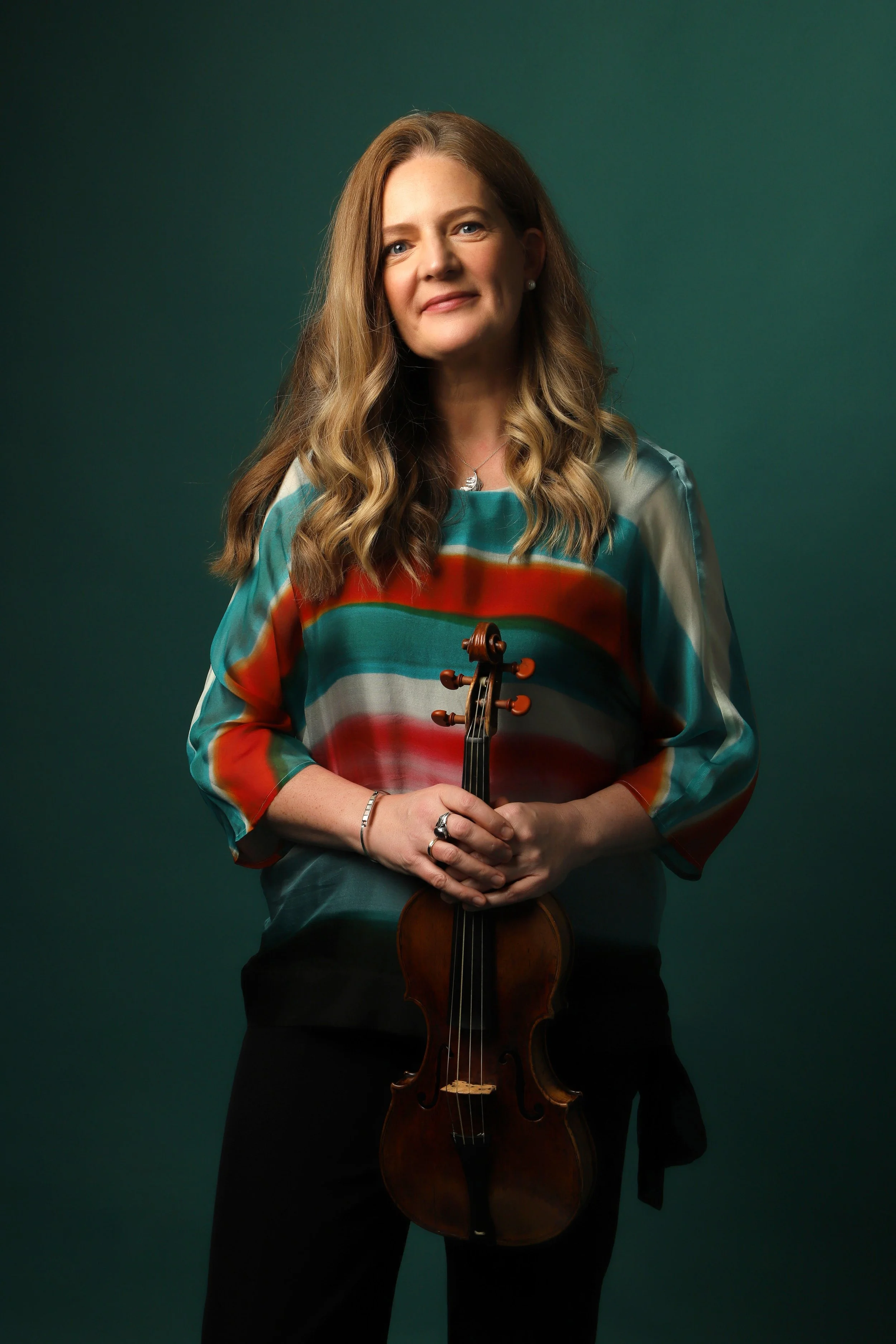
Photo credit: Broadway Studios
Rachel Podger, violin & Lucie Horsch, recorders: Duologues
Lakeside, Nottingham | 31 October 2026
⭐⭐⭐⭐⭐ Review by William Ruff
“You won’t hear Baroque duos for violin and recorder sounding better than this.”
There was surely no better way of avoiding Saturday night’s trick-or-treaters than to be in the company of Rachel Podger and Lucie Horsch at their Lakeside concert of Baroque duos for violin and recorders. There is simply no one better in this repertoire – and they not only offer exhilarating playing but also love communicating to their audience about what they are playing and how they are playing it.
This Lakeside concert came as part of a tour in which they have had the time and space to develop ideas, to experiment, to take risks. This element of improvisation injected spontaneity into the concert, turning it into a vibrant conversation across the Baroque era, with the violin and recorder as equal partners in intimate musical dialogues, formal grandeur rubbing shoulders with courtly elegance.
Rachel Podger began alone with a radical reimagining of what must be the most famous organ work ever written: Bach’s Toccata and Fugue in D minor. When you hear it played on a solo violin, however, it’s not hard to believe that is where it must have started its life: it’s just so idiomatically written for the baroque violin and its bow. In this arrangement by Chad Kelly, Rachel had to use all the resources of her instrument to conjure the Toccata’s dramatic flourishes and the Fugue’s intricate, relentless momentum. The piece was stripped back to its essence, the result surprisingly convincing.
Georg Philipp Telemann came next: a piece from his Faithful Music-Master, in which the composer treats the two players as equal conversationalists, creating a lively and elegant dialogue full of his characteristic wit and melodic charm, allowing both Rachel Podger and Lucie Horsch to wring every ounce of colour from their instruments.
Then came Lucie’s turn to perform solo: another piece by Telemann, his Fantasia ‘a la Francese’. Lucie’s playing showcased the recorder’s agility and its range of expression. Together Lucie and Rachel also performed Telemann’s Canonic Sonata No 1, making it a fascinating display of imitative counterpoint, where the second instrument enters in strict canon with the first (think of the way in which voices enter in something like Frère Jacque), creating a satisfyingly seamless musical fabric.
There were a couple of lively gigues as well: one from Bach (for recorder), the other (for violin) from Montanari. Both displayed the virtuosity of the two artists, showing that the recorder can match the violin in brilliance and agility. The Montanari is a rarity, a whirlwind of rapid passagework, string crossings in a dazzling display of technical prowess and rhythmic drive.
The programme also contained some graceful, tuneful Boismortier and ended with a set of traditional melodies, by turns poignant and toe-tappingly lively. It’s not surprising that the concert was a sell-out. Here was the essence of chamber music: lively musical dialogues between equals, performed by two artists at the top of their game and communicated to the audience with exuberant virtuosity and the joy of sharing musical passions.
Rachel Podger (violin) and Lucie Horsch (recorders): Duologues