Springwood by Richard Nelson, Hampstead Theatre, Eton Avenue, Swiss Cottage, London NW3 |until 25 July 2026 ⭐⭐⭐⭐ Review by William Russell
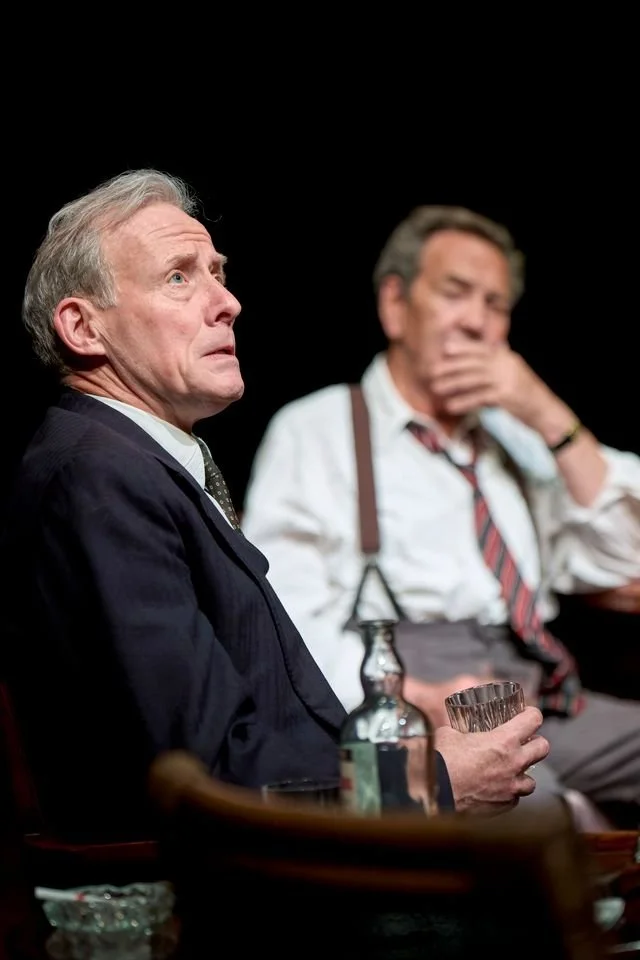
Photo credit: Manuel Harlan
Springwood
by Richard Nelson
Hampstead Theatre, Eton Avenue, Swiss Cottage, London NW3 |until 25 July 2026
⭐⭐⭐⭐ Review by William Russell
“How the special relationship was formed.”
In June 1939 King Gorge the Sixth and Queen Elizabeth went on a state visit to the United States. It was an add on to their Coronation tour of Canada and the invitation from President Franklin D Roosevelt was accepted as war was looming with Germany and American public opinion was fiercely isolationist. Richard Nelson's play is based on his film Hyde Park on the Hudson about how after two days of events in Washington – the usual works – the Windsors accepted an invitation to stay at Roosevelt's home where the couple struck an amazingly real friendship which, while it did not secure any change in the United States position, it took Pearl Harbour to do that, was the foundation for what became known as the special relationship. The Roosevelt marriage was distinctly odd – they were clearly devoted to one another, but she has intense relationships with other women, he was unfaithful despite his polio which confined him to a wheelchair with more than one woman and at this point possibly with Daisy Suckley who was some kind of secretary companion. .The play was to have been directed by Stanley Tucci, but scheduling problems prevented that and Nelson has done it himself and the result is one of those curate's egg evenings – fine performances from his cast but people doing things devised by the director that they would never in a month of Sundays have done in real life. There is a man from the British Embassy, for instance, whose behaviour would have been impossible then and now. Elizabeth is dressed most oddly because the photographs of the visit show her already then in the style of gown and hat that became her trademark, not neat little cardigans and plain fawn dresses, People go about bare foot for no good reason, the maid is patently rude and hostile and casting Andrew Havill, who is a couple of decades older than Bertie was at the time, is most odd, except that audiences today probably have next to no idea of what Bertie looked like – or, if they do, think Colin Firth. Nelson has very clear ideas of how plays should be performed and the theatre has been reconfigured so that the acting area is surrounded on three sides and the set consists of a lot of pieces of furniture which keep getting trundled on and off by the cast as we move from one part of the Roosevelt homes, a series of cottages, to another. This gets very annoying although one does admire how well they do it. But the cast do wonderful things even if Jemma Redgrave is really too good looking to be Eleanor who was, to put it politely, handsome at best. Robert Lindsay creates a terrific Roosevelt, partly because people have really no idea of what he looked or sounded like so he can go about his job as an actor which is to create a character. What emerges is that Roosevelt is well aware that war will c me and the United States cannot stay out of it, but there is nothing he can do at this moment, but the two odd couples form a friendship which was genuine - they corresponded to one another subsequently, and which did form the basis of what became known as the special relationship, that comfort blanket to which we have lung until Trump came along. Perhaps writers should never direct their own plays, Perhaps the material needed that outside eye looking at it. You do wonder about the phone call Elizabeth made to her daughters which apparently leaves them in tears because if they have been away for some time, it cannot have been the first one, and just why Scottish Elizabeth Bowes Lyon should announce she is English is one of those things as is everyone calling the pair royal highnesses. One great problem about the visit was the party the Roosevelts had planned at Springwood when hot dogs were to be served, food treated by the Royals as something dangerous. That may have been the case, but the Embassy man might have explained that they are a sausage in a bun on which mustard is spread as thickly as you wish. Eating them, which went down well with the American public then, was vital as it gave the pair the common touch, stopping them being posh folks from abroad. Some of what one sees is funny, some touching – Bertie confiding to the President over a lot of Scotch about his ghastly childhood, he had the parents from hell, and Roosevelt being equally open about life in a wheelchair but not being seen in one by the people. Coming on top of the recent visit by King Charles it is all the more fascinating and worth collecting for itself but also as for some fine performances, notably from Redgrave and Lindsay.
