The Death of Robin Hood (2026), Dir Michael Sarnoski, True Brit Entertainment ⭐⭐⭐⭐⭐ Review by Matthew Alicoon
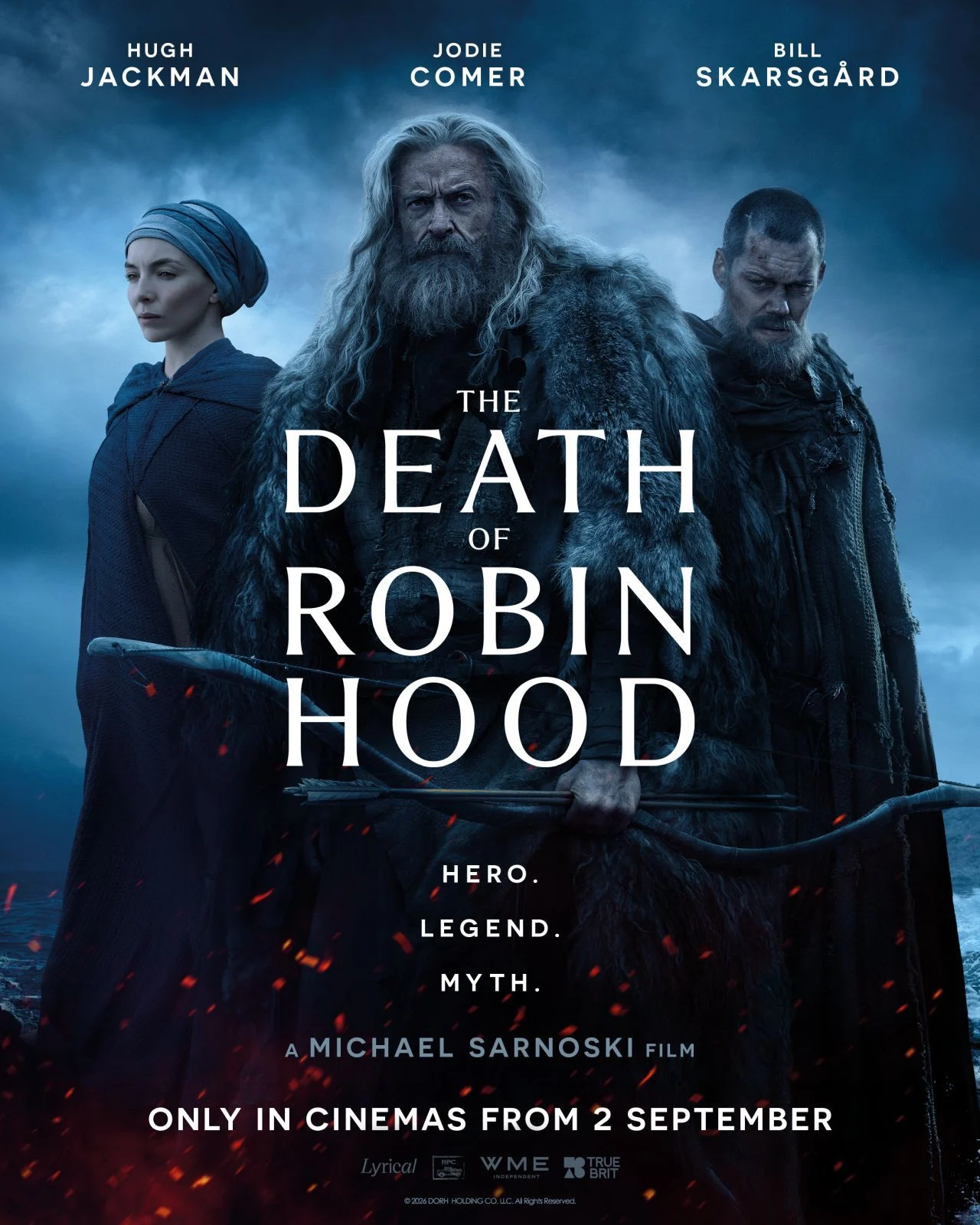
The Death of Robin Hood (2026)
Dir Michael Sarnoski
True Brit Entertainment
⭐⭐⭐⭐⭐ Review by Matthew Alicoon
Running Time: 122 Minutes
“A profound exploration into the man behind the legend, asking what legacy we leave behind?”
Based off the 17th-century ballad Robin Hood’s Death, The Death of Robin Hood follows an aged Robin (Hugh Jackman) who is brutally injured and takes refuge in a priory. Robin is heavily traumatised by his past-killings and lives in a self-imposed exile.
I have been waiting two years to see The Death of Robin Hood, partly because of my own connection to the mythology. During my Masters at the University of Salford, I wrote a TV series outline that reimagined the Robin Hood mythology in a contemporary setting. I even cast Jodie Comer as Marian. To then see Jodie Comer appear in an entirely different interpretation of Robin Hood two years later feels like an extraordinary piece of cinematic synchronisation. However, putting that personal connection and any biases aside, Michael Sarnoski's film completely exceeded my expectations.
What makes The Death of Robin Hood instinctively remarkable is how profoundly human it is. Beneath the mythology is a quietly devastating meditation on history, mortality, guilt, forgiveness, identity, legacy and what it means to live with the consequences of the person you once were.
From its opening moments, the film establishes that this is not the Robin Hood of legend. The heroic outlaw is stripped away, leaving an ageing man forced to confront the reality of his past. Robin was a thief who committed acts of violence and ultimately took things too far. The moral compass is incredibly enriched, as Robin is no longer capable of hiding from the truth. The film is not interested in reconceptualising Robin into a misunderstood hero; instead, it explores the conflict between the legend of Robin Hood and the reality of who the man represents.
Hugh Jackman gives one of his finest ever performances. There is an extraordinary emotional weight behind his eyes, with so much of Robin's history communicated through his expressions rather than dialogue. His face constantly conveys the burden of a lifetime of violence, regret and guilt. The performance feels almost entirely lived-in, and alongside his work in Prisoners and Logan, this is arguably one of the most astounding performances of his career.
Jodie Comer is equally magnetic as Sister Brigid. Comer remains my favourite actress working today. Brigid is one of the film's strongest characters, built around a philosophy of preserving and protecting life while carrying the consequences of her own past. Her relationship with Robin becomes increasingly complex, as the film refuses to offer an uncomplicated understanding of forgiveness. A critical question of the film asks, “What does compassion mean when the consequences of someone's actions are irreversible?”. The film capitalises on how remorse cannot restore what has been lost. Jim Ghedi’s soundtrack is brilliantly sympathetic in complementing the themes of the film.
The stunning sheer beauty and breathtaking landscapes by cinematographer Pat Scola became increasingly fascinating to me the more I thought about it. The cinematography gives the natural world an almost spiritual presence, creating a striking contrast between the flourishing life surrounding Robin and his own internal sense of exhaustion. Director Michael Sarnoski depicts the priory as a place where life is flourishing at its finest. However, one of the best oppositions is that Robin seems incapable of seeing himself as part of that life anymore. I found myself wondering whether the locations could almost represent Robin's own version of hell, as an inevitability for a life he cannot settle into.
There are moments of visceral and extreme brutality with the violence. Michael Sarnoski never seems interested in violence for the sake of it being excessive. The important question is what remains in the aftermath of violence. Violence creates consequences, grief and trauma that cannot simply disappear when the act itself is over. There was a particularly significant revelation surrounding his history that adds another devastating dimension to that idea.
The film is also deeply interested in the distinction between history and mythology. Who gets to write history? Who decides which version of a person survives? Robin the man and Robin Hood the legend becomes increasingly difficult to separate, yet the film understands that they are not necessarily the same thing. That bizarrely makes the title “The Death of Robin Hood” carry enormous weight. It is not simply referring to the death of a man. It can be read as the death of an identity, mythology and a version of Robin Hood that has existed for generations.
The final image of the film is lingering. The ending becomes one of the film's most powerful symbols with a remarkable representation of legacy and the passing of an idea. The film spends so much time asking what Robin Hood actually represents.
What I admire most is that the film never reduces its plethora of ideas in a simplified manner. It asks whether someone can be forgiven when saying sorry is not enough. The film explores if a person can truly escape the identity created by their past. Whether history remembers people as they truly were or as the stories told about them afterwards. Finally, whether dying can represent acceptance and a final act of ownership. This feels so much more than a Robin Hood film. It is a film that explores the man beneath the legend, tackling the psychological consequences of violence and the impossible burdens of reconciling with the past.
Quiet, reflective, observant, visually magnificent and deeply philosophical. The Death of Robin Hood has stayed with me more than almost anything I've seen this year. My connection to the mythology helped tremendously, but I am blown away by the extraordinary complexity Michael Sarnoski has brought to the material. Hugh Jackman and Jodie Comer are just tour-de-forces.
Cast
Hugh Jackman - Robin Hood
Jodie Comer - Sister Brigid
Bill Skarsgård - Little John
Murray Bartlett - The Leper
Noah Jupe - Arthur/Godwyn
Faith Delaney - Little Margaret
Crew
Director – Michael Sarnoski
Writer - Michael Sarnoski
Producers - Aaron Ryder, Andrew Swett, Alexander Black & Hugh Jackman
Cinematographer – Pat Scola
Editor – Andrew Mondshei
Music – Jim Ghedi