Feature Part 2: Seeing With My Dog by Roderick Dungate
Feature Part 2: Seeing With My Dog
Earlier in ReviewsGate (https://www.reviewsgate.co.uk/features-interviews/seeing-with-my-dog-by-rod-dungate) award-winning playwright and poet, and founder editor of ReviewsGate, Roderick Dungate, wrote about preparations for the first read-through of his extraordinary, semi-autobiographical play, Seeing With My Dog. Here, he explains how he moved from read-through to the version of the script to be used in rehearsal, starting mid March.
I went into the first read-through in January with a heady mixture of excitement and trepidation.
It was the first time the four actors were together. Tej and Leonie (Guide Dog Jason and Guide Dog Trainer Kate) are West Midlands based. Giles and Lee, both vision impaired actors (protagonist Oliver and Chimp Twist) are based in London. So the actors are not only meeting together for the first time, but also reading the script out loud together for the first time.
It’s also the first time I’ve heard it out loud. Will it sound as I imagine it? The answer to that one is certainly ‘No’. Each actor brings their amazing creativity to the play; they are artists, too. The characts I imagine and the characters they imagine eye each other up over a distance; in rehearsal they will move together and eventually merge.
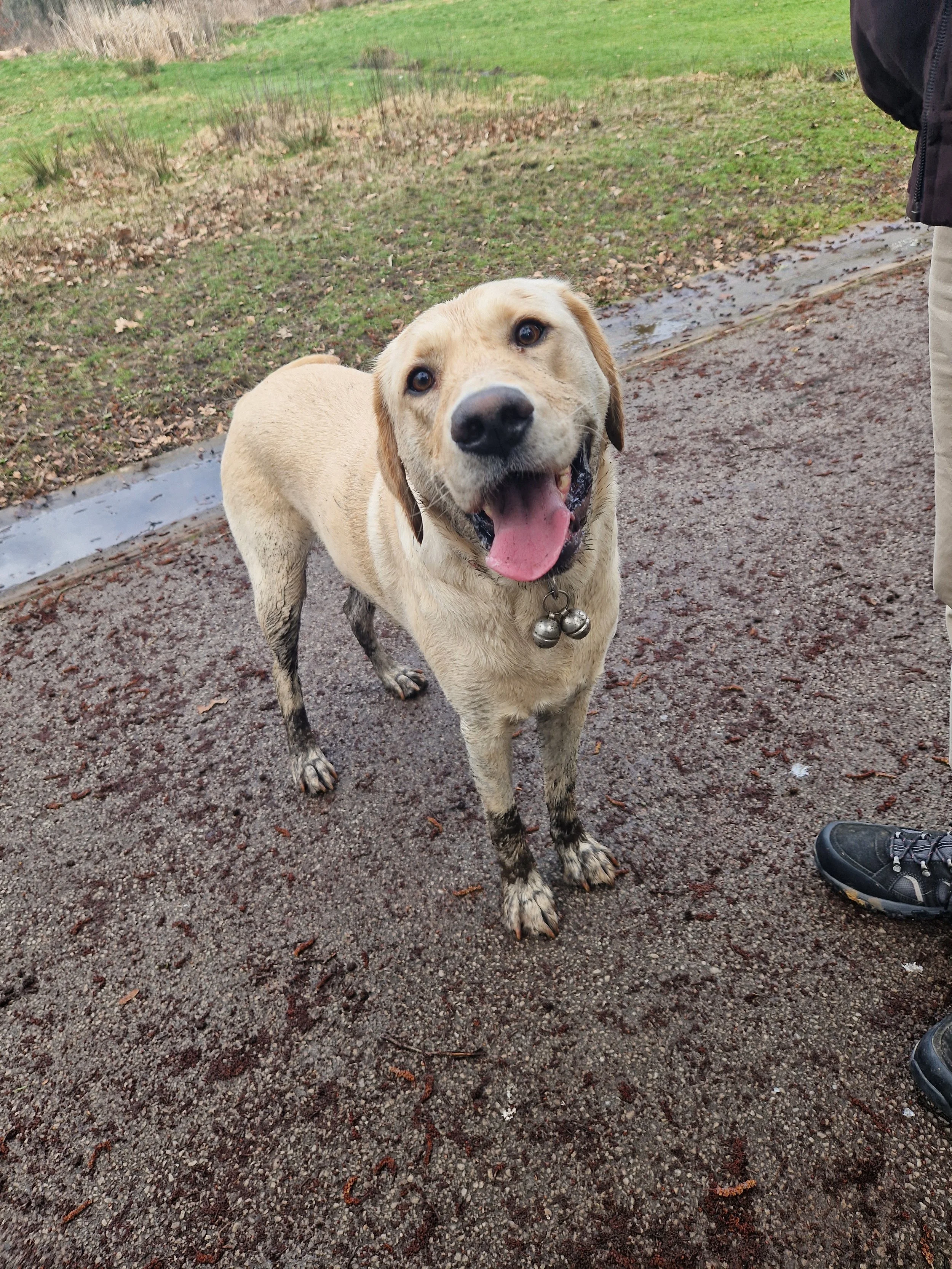
Also in the room are co-director Joe, movement director, Lucy, and a friend, Philip, with his guide dog, mason. My guide dog, Dixon, is, of course, also there to comment.
The reading was a most happy occasion. Lots of laughs. Thoughtful discussions. Moments when lines resulted in an explosion of laughter. All incredibly rewarding. Moments, too, of quietness as other, more sensitive, episodes were read. The only real downer was that someone pinched my Jaffa cake, and I had to resort to Rich Tea; life can be very unfair.
Joe, co-director, and I had a lengthy discussion after the reading. Joe suggested I look at a crucial scene when Oliver, the protagonist, (at that point at his lowest) has to say Goodbye to his guide dog trainer, Kate. Kate is moving away. Seeing With My Dog is a verse play; but this particular scene is written in prose. It’s deliberately sparsely written; but Joe suggested I hone it further. It was a tough call.
I have a Golden Rule in playwrighting: Let the actors act. In this scene, as it now is, all the meaning is carried under and between the words. Actors love to do this; I hope I am giving them the chance.
Both Joe and I agreed the scenes leading up to the final scene needed attention. Though, at the time of our discussion, neither of us was able to say in what way they should be changed.
I went back to one of my research sources, an intriguing book called The Chimp Paradox by Professor Prof. Steve Peters– it’s where the idea of the character Twist came from. I realised that, as the play moves towards a resolution I was taking the wrong approach to them. I needed to do a writing U-turn. It was a really tricky piece of rewriting, but I think well worth it. Better for the narrative and a better live curve for the characters – and, hence, more rewarding for the actors.
The final major scene rewrite came upon me suddenly; I had never queried the scene up to this point. There was a dream sequence in the play (cheesy, yes, but deliberately so). At the last minute I realised the scene had lost its purpose. I was working on how to get into the scene and took the cue from this. The play didn’t need a dream scene; it needed a nightmare.
Challenging; I’d never written a nnightmare before. I tried out some thoughts on friends, and it made them laugh. So I did the rewrite; the result is a scene that fits much more snugly into the jigsaw a play is.
Then came the final go-through of the script. Going through the script, slowly, from top to tail. This is a joy. Examine each word and line in detail. Writing better lines sometimes. Improving comedic lines. Comedic lines don’t just happen; they are precisely sculpted. Extraneous words must be dumped, the punch must come at the end, the meaning must be instantly understood, the rhythm must be right. It’s why actors cannot (and do not) approximate comedy lines. They must be 100% accurate.
The preparation of this rehearsal script took much longer than I had thought it would. It’s with the company members now.
The proof of the pudding …