Dudok Quartet & Pieter Wispelwey (cello), Lakeside, Nottingham | 19 March 2026 ⭐⭐⭐⭐⭐ Review by William Ruff
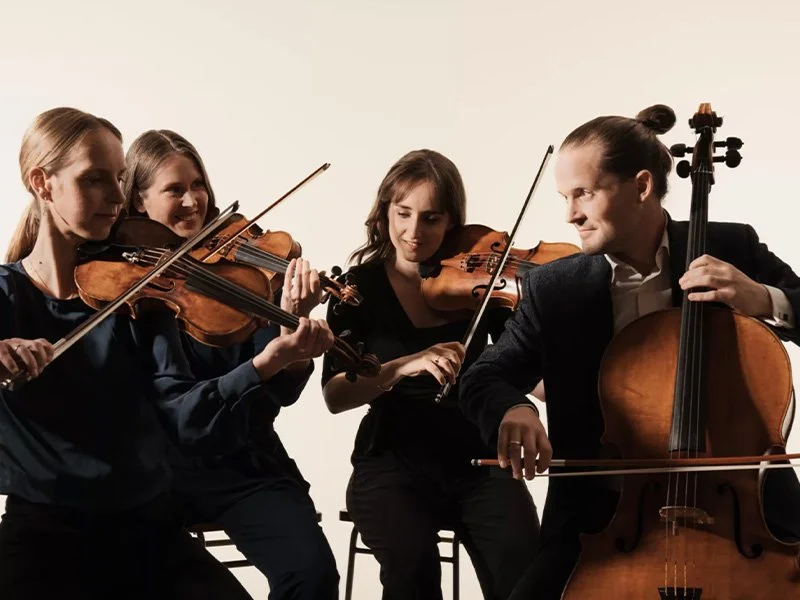
Photo credit: Lakeside
Dudok Quartet & Pieter Wispelwey (cello),
Lakeside, Nottingham | 19 March 2026,
⭐⭐⭐⭐⭐ Review: William Ruff
“Performances which traverse a profoundly moving emotional landscape.”
Schubert’s String Quintet is one of chamber music’s very greatest works. If you sift amongst Desert Island Discs’ all-time favourites you’ll not only find that many great minds have chosen it but also that it’s the music they would like to accompany them from this world to the next. It’s hardly surprising that the Dudok Quartet from Amsterdam should have made it the starting-point and purpose of their Lakeside programme: this is clearly music which flows in their veins.
The whole programme was founded on the fact that Schubert requires two cellos for his Quintet, so everything else they played was arranged for that very distinctive combination: two cellos plus two violins and viola, creating a dark-hued, sumptuous bass register that has depth and resonance. Schubert achieves something very special, allowing for poignant duets between the two low instruments and freeing the first cello to soar as a singer of melody. Pieter Wispelwey was the extra cellist.
Schubert’s Quintet took up the whole of the concert’s second half. Leading up to it was a cleverly devised first half of music arranged for the five string players, all of which was other-worldly to some extent. The Dudoks opened with the Entrée de Polymnie from Rameau’s final opera Les Boréades, four minutes of sensuous harmonies capturing the moment when one of the ancient Greek Muses descends to offer divine consolation.
Then came the melancholy of the Elizabethan court as the Dudok Quartet played four of John Dowland’s Lachrimae (‘tears’), sorrow transformed into art. They are pieces at once intimate and ceremonial, one of them even bearing the punning Latin title ‘Semper Dowland, semper dolens’ (Always Dowland, always grieving). Their choice of four dances captured the essence of the set: music that is not only serene and poignant but which can also be bright and rhythmically alert, full of courtly elegance. However, in these thoughtful Dudok arrangements it was apparent that, even when rhythms were crisp and the mood courtly, we could sense a shadow falling, reminding us that in Dowland’s world even joy is never free from the cares of melancholy.
Following this, the Dudok Quartet leapt over 300 years to perform the Adagio from Anton Bruckner’s String Quintet, the heart of his only chamber work. At first sight this would seem to be a surprising bridge to erect between Dowland and Schubert but the Dudoks have imagination and sound judgement. The Bruckner unfolded like a private prayer, its long-breathed melodies building to moments of overwhelming intensity before retreating again into serene devotion.
And then came the Schubert Quintet, one of music’s supreme masterpieces, a work of visionary power, completed just two months before his untimely death. The composer never heard a single note performed. Across four vast movements the Dudok Quartet (with Pieter Wispelwey) traversed a deeply moving emotional landscape: the life-and-death struggle of the first movement; the transcendent stillness of the Adagio; the rustic energy of the Scherzo; the life-affirming finale. This performance reached deep inside music which portrays joy and sorrow not as opposites but as eternally intertwined. The result was deeply satisfying.
DUDOK QUARTET
Judith van Driel, violin
Marleen Wester, violin
Marie-Louise de Jong, viola
David Faber, cello
with Pieter Wispelwey, cello