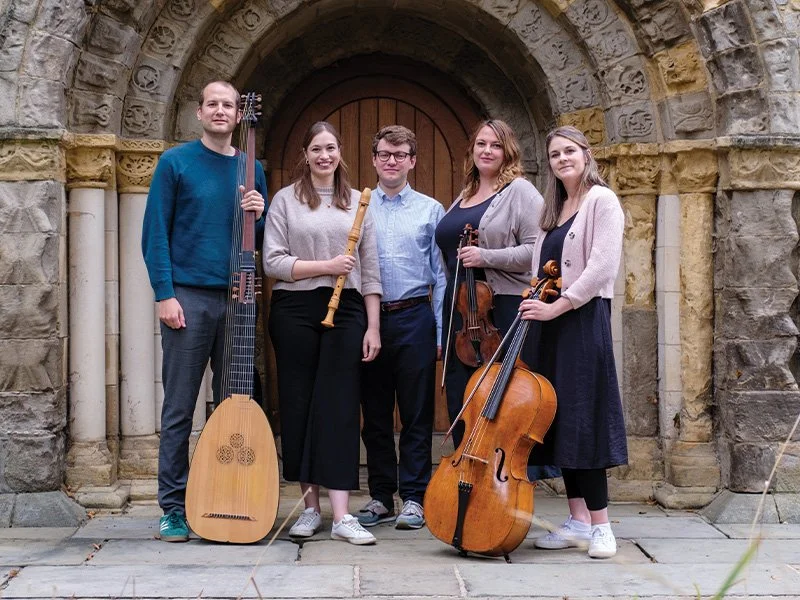
Photo credit: Lakeside
Ensemble Augelletti
Lakeside, Nottingham | 11 June 2026
⭐⭐⭐⭐ Review by William Ruff
“Intimate musical conversations between equals.”
It probably won’t be long before Elon Musk invents time travel. In the meantime music-lovers have groups such as the Ensemble Augelletti to whisk them back through the centuries for a taste of what musical life was like in the past. They specialise in chamber music of the 17th and 18th centuries, a time when it was generally available only to aristocrats and members of the upper middle classes, when the setting was intimate and connoisseurs could appreciate the music and its performance.
The focus of this Lakeside concert, however, was a bit different because the Augellettis’ time machine decided to land in early 18th century Leipzig, a city to which musical pilgrims still flock to pay homage to the great Johann Sebastian Bach, whose home and workplace it was for most of his career. And Leipzig had another important claim to fame: its Collegium Musicum, a musical society founded by Telemann (another prolific composer) in 1702. It consisted mainly of university students, dedicated to performing instrumental and vocal music for pleasure.
Bach became its Director from 1729 and it met in the city’s Café Zimmerman, becoming a hub where top students could rub shoulders with top musicians and together could make music in a stimulating and congenial atmosphere. So if you closed your eyes on Thursday night, you could just about imagine yourself in this world – except that Zimmermann’s wasn’t a concert hall, and there would have been a lot of people chatting in Bach’s day…and drinking coffee.
The Ensemble Augelletti played nine pieces: by Bach and Telemann and by others associated with the Collegium Musicum such as Hasse, Locatelli, Torelli and Fasch. If this all sounds like a set of unvisited exhibits in the cultural museum, it’s worth saying that this Lakeside programme was a refreshing antidote to our world of streaming and noise. Five musicians played a series of sonatas (on recorders, violin, viola da gamba, lute and harpsichord), so textures seemed transparent. You could hear every part in high definition – and it as all very egalitarian. In the Telemann trio sonatas, for instance, or the opening Fugue by Anna Amalia the interplay between the players felt like a civilised conversation, the voices taking turns, agreeing, playfully arguing. Each of the movements performed (and there were 27 in total) expressed one core mood, (gentle sorrow, buoyant joy, dignified gravity etc) with the Augellettis making the most of the music’s emotional directness, intellectual playfulness and virtuosity.
This sort of thing isn’t for everyone, of course. Once you take the music out of its café context and focus on it for two hours, it’s hard not to notice the lack of variety – and you’d be hard-pressed to tell your Hasse from your Fasch. And not all ears will take kindly to the combination of pure recorders set against the somewhat astringent baroque violin. Playing on instruments of this period will always cause a few problems with tuning (despite having an electric blanket on hand to revive the recorders between pieces) and occasionally there were issues with ensemble (notably in the slow movement of the Bach Sonata in G minor). However, the enthusiasm of the Ensemble Augelletti was never in doubt. Together with their individual and combined expertise it made them persuasive advocates for music which allows us to eavesdrop on 300-year-old musical conversations between equals.
Ensemble Augelletti:
Olwen Foulkes – recorders
Ellen Bundy – violin
Kate Conway – cello & viola da gamba
Toby Carr – lutes
Oliver John Ruthven - harpsichord