Julian Bliss, Maxim Rysanov and James Baillieu play Mozart and Schumann, Lakeside, Nottingham | 26 February 2026 ⭐⭐⭐⭐⭐ Review by William Ruff
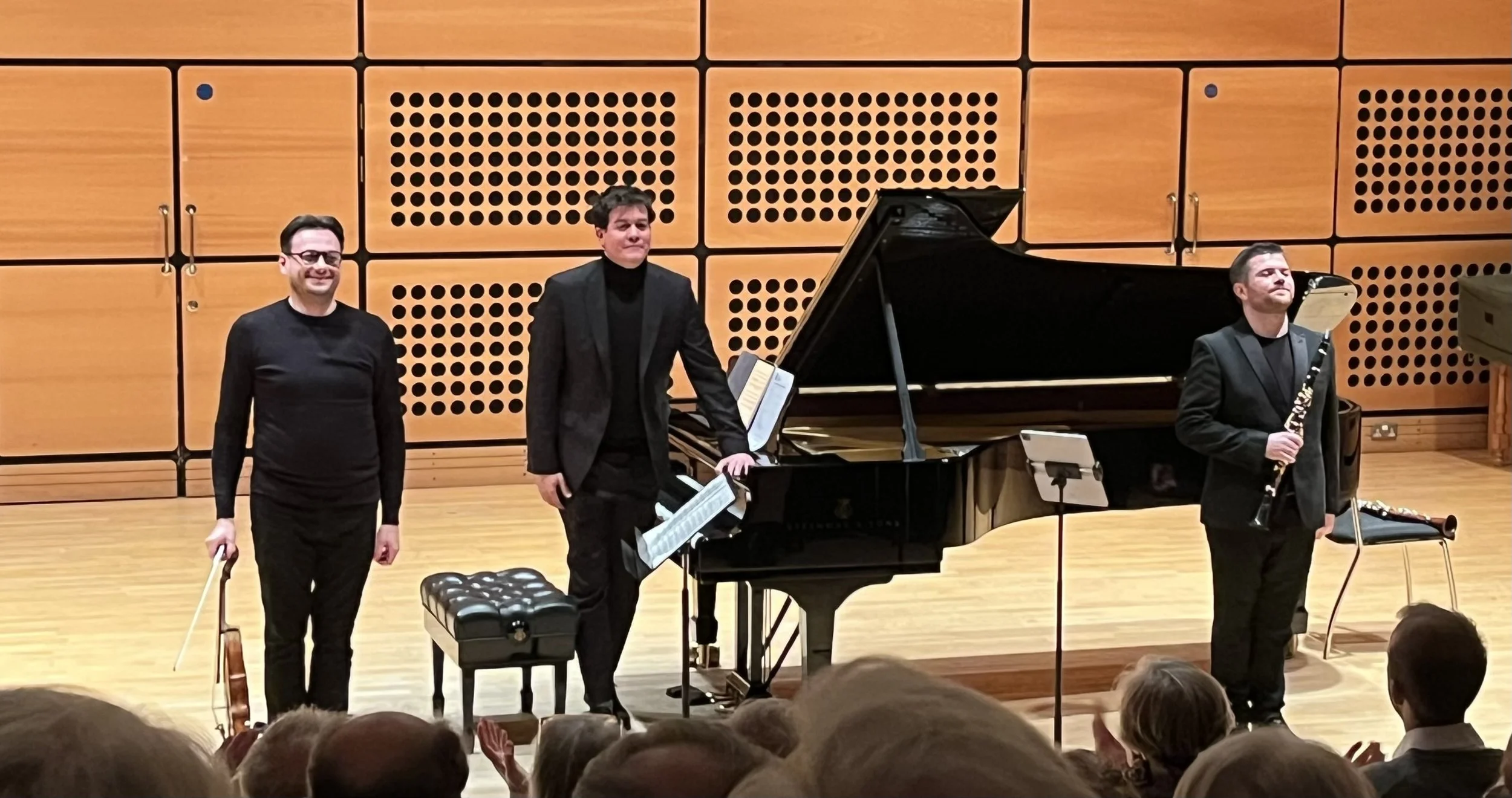
Photo credit: William Ruff.
Julian Bliss, Maxim Rysanov and James Baillieu play Mozart and Schumann
Lakeside, Nottingham | 26 February 2026,
⭐⭐⭐⭐⭐ Review by William Ruff
“Eloquent, civilised musical conversations.”
If anyone wants to know about Lakeside’s Djanogly Recital Hall, just say it’s a venue where musicians such as Julian Bliss, Maxim Rysanov and James Baillieu feel at home making music. All three are world-class musicians, each of whom sports the sort of CV which mere mortals are advised to read sitting down with a calming cup of tea. They have all trodden very big stages across the globe but anyone who has experienced the acoustics, intimacy and warmth of Lakeside won’t be surprised that musicians of such calibre are drawn to it.
They began their programme with Mozart’s Trio for Clarinet, Viola and Piano, the so-called ‘Kegelstatt’ Trio, its name almost certainly a mistake, as ‘Kegelstatt’ means ‘bowling alley’, a nickname that has stuck despite having little or nothing to do with where the piece was composed. Mozart loved the clarinet, a fairly new instrument at the time he composed this work (1786), having been inspired by the playing of two brothers, Anton and Johann Stadler. In this Trio Mozart exploits the clarinet’s mellow quality to the full, blending it subtly with the viola and piano and writing long, aria-like melodies for it.
In fact, in this performance all three instruments became like vividly realised characters in a Mozart opera, engaging in a variety of soulful and spirited conversations. Julian Bliss’s clarinet and Maxim Rysanov’s viola shared a special kinship, both rich and sonorous. James Baillieu added sparkle to a conversation which had both charm and wit, singing from beginning to end, nowhere more so than in the sparkling finale and its exhilarating (and highly operatic) final few bars.
Julian Bliss then left the stage for Maxim Rysanov and James Baillieu to perform arrangements of four songs from Robert Schumann’s song-cycle Dichterliebe as well as his Adagio and Allegro, originally for horn and piano but seeming to work just as well (and possibly better) for viola. The rapport and sensitivity of the duo were plain to see, as well as to hear.
The second half began with Maxim Rysanov taking a rest and Julian Bliss returning to perform (with James Baillieu) songs by Robert Schumann and his wife Clara (with such intensity of feeling that you hardly missed the words at all) as well as the set of Schuman’s Fantasy Pieces, in this performance crafted into a perfect fusion of poetic sensibility and instrumental dialogue.
All three musicians reassembled to end their programme with Schumann’s Märchenerzählungen (Fairy Tales). The unusual combination of timbres—the mellow warmth of Julian Bliss’s clarinet, the darker, more plaintive voice of Maxim Rysanov’s viola, and the harmonic foundation of James Baillieu’s piano—created a veiled, autumnal, and deeply poetic sound world well suited to the work’s title.
The heart of this performance was the third movement with its sublime, songlike beauty, viola and clarinet intertwining in a long-breathed, expressive duet over the piano's delicate harmonies, creating a mood of tenderness and nostalgia. In the finale the instruments engaged in a breezy, animated conversation, bringing both the musical fairy tales and the concert as a whole to a spirited and life-affirming close.
Julian Bliss (clarinet), Maxim Rysanov (viola) and James Baillieu (piano)