Kazuki Conducts Mahler’s 2nd Symphony, CBSO, Symphony Hall, Birmingham | 17 September 2026 ⭐⭐⭐⭐⭐ Review by David Gray & Paul Gray
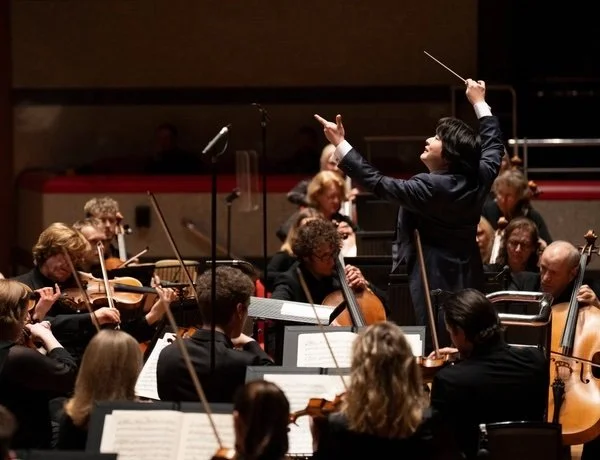
Kazuki Conducts Mahler’s 2nd Symphony
CBSO, Symphony Hall, Birmingham | 17 September 2026
⭐⭐⭐⭐⭐ Review by David Gray & Paul Gray
“…an impressive way to start a concert season.”
Mahler’s 2nd Symphony will never fail to be an impressive way to start a concert season. And it is a work with particular importance for Symphony Hall audience members who remember as far back as the venue’s inaugural concert with Sir Simon Rattle. Here, the vast scale of the work was used to showcase the astonishing and ground-breaking new acoustic of the Hall to dramatic effect.
And drama abounded in this expansive and intelligent reading of the Symphony. Conductor, Kazuki Yamada and his orchestra delivered a performance which combined big contrasts, and a deep understanding of the musical architecture of this work, with insightful attention to detail.
The opening moments felt very deliberate. Great attention was placed on articulation, with some quite daring long pauses and pregnant rubato. This was a taste of things to come. The reading demonstrated Kazuki as a conductor unafraid to keep his audience waiting, and to build a sense of expectation and tension. Quite thrilling.
The opening Allegro maestoso was well paced with a clear line of argument. Kazuki maintained momentum and direction through the movement’s sequence of cataclysmic climaxes, collapses, and musical resurrections.
The movement always felt like it was going somewhere. Indeed, as deep musical analysis shows, there is a remarkable mathematical structure built into this expanded & altered (so-called) ‘sonata form’ – or ‘sonata style’ - movement. And this pure ‘mathematical structure’ is on an equal par with the kind of perfect math one finds in a Bach or a Mozart - and don’t get me started on the (more controversial) - but seemingly evident - use of the so-called ‘golden ratio’ or ’golden section’ in this movement.
And, like Rattle before him, Kazuki instinctively emphasised the ‘structural downbeats’ of the mind-bendingly precise algebraic layout of this astonishing movement. Who knew that pure math could sound this good?! And it may surprise many that one finds it in a composer such as Gustav Mahler, whose music is often accused by its detractors of being ‘too long’, ‘too rambling’ or ‘too emotionally indulgent’.
Added to this, Kazuki really brought out a plethora of detail to his unique reading, and a feeling of hearing the work afresh with new ears. It was, at times, quite revelatory.
The Andante Moderato was stately, suave and elegant, but not without moments of heightened emotion. The third movement – a Scherzo all about futility - was delivered by Kazuki and his band with relentless energy and drive and, again, with tremendous attention to the smallest of details.
Contralto, Jess Dandy, has the perfect voice for this work. Her ‘Urlicht’ fourth movement was rich, powerful when it needed to be, yet tender and heartfelt, with gorgeous pianissimos floating out into the huge, welcoming acoustic of Symphony Hall. Indeed, we pair of humble music reviewers were seated dizzyingly high in the very backrow of the Grand Tier; from where the performers looked like insects – but we perfectly heard – experienced – every single sound & every single word of lyrics.
Jess Dandy paired well with soprano Eleanor Lyons in the final movement. But the real star of this finale was the CBSO Chorus, giving their 1000th performance as a choir since their founding in 1973/4.
The Chorus - singing without music and at first seated - enabled them to focus on the conductor and really communicate. The almost whispered sotto voce passages were invested with an electrifying intensity. And when they gave it their all in the closing sections, there was visceral power and solidity to the sound.
Of course, what can one say of the CBSO Chorus? One could hear every word, every syllable, every consonant of the text. The CBSO Chorus performed with levels of dynamic contrast, textural control, and total balance of (a very large) ensemble, to utter perfection. Bravi.
Kazuki shaped the Finale with complete control, building and maintaining dramatic tension through to an emotionally shattering and utterly cathartic climax. This really was a top-notch performance by the CBSO.
Kazuki Yamada – Conductor
Eleanor Lyons – Soprano
Jess Dandy – Contralto
CBSO Chorus
Julian Wilkins – Chorus Master