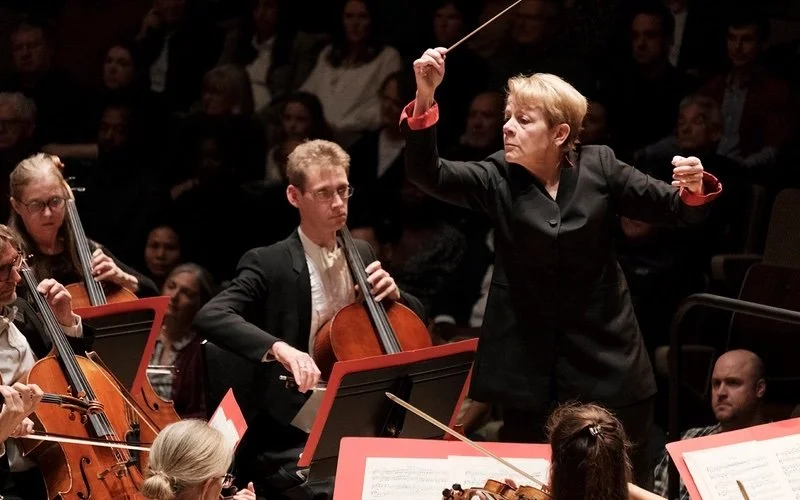
Photo credit: Alejandro S Garrido
Marin Alsop Conducts the Philharmonia Orchestra
Symphony Hall, Birmingham | 22 November 2026
⭐⭐⭐⭐⭐ Review by David Gray & Paul
“Contrasting but complementary works by Bernstein and Mahler make for a very satisfying programme.”
Leonard Bernstein – Serenade after Plato’s Symposium
Gustav Mahler – Symphony No. 6
Bernstein’s Serenade after Plato’s Symposium is a work of varying moods: lyrical, melancholy, playful. Violin, Esther Yoo captured these moods beautifully, playing with a soaring, pure, almost ethereal tone.
Her playing of the song-like opening melody was articulated with intelligence and communicated with conviction. The string sections entered contrapuntally, one by one, with absolute sensitivity to the need for balance. The result was delicate and tremendously expressive.
This sensitivity characterised the rest of the piece, which is a true conversation between band and soloist. The work is like a concerto in this respect; however, it is also unlike a concerto in its relative lack of showy virtuosity. This is more of an intimate piece full of charm and melodic appeal. Conductor, Marin Alsop invited us to join the conversation, and with playing of this quality by Yoo and the Philharmonia, who could refuse such an invitation.
The Philharmonia leader – together with lead ‘cello and lead double bass - all got the chance to duet with Yoo and achieved a feeling of real rapport; particularly the double bass who provided jazzy, syncopated interpolations in the quirky, woozy final movement.
It was clear from the outset that this was going to be a bold and energetic performance of Mahler’s 6th Symphony. The Philharmonia’s lower strings attacked the opening bars with gusto and relish, while the rest of the orchestra delivered the menacing march with focus and exemplary clarity. All the detail was there from a hugely expanded wind section, as was the sense of blend and balance.
As the movement progressed, lustrous upper strings gave the so-called ‘Alma’ (love) theme a surging and yearning intensity. Conductor, Marin Alsop worked the contrasts without over-exaggerating, making the argument and structure of the work crystalline.
Alsop really brought out the inner sense of the proportions of the movement, highlighting its structural ‘downbeats’ without hammering them home. This intimate communication between Alsop and the orchestra meant that the complex textures flowed - but never blurred - and always felt fresh and spontaneous.
This really thrilling opening movement was followed by an exquisite, delicate and perfectly poised Andante. There was some lovely lyrical playing here, with hushed breathy textures which really showed an understanding of the Hall’s remarkable acoustics. And – as for the movement’s famous big, sequential love melody – there must have been many a moist eye in the audience beside our own.
After a detailed reading of the Scherzo, Alsop hurled us headlong into the tempestuous travails of the huge Finale. Again, the conductor used her clear understanding of the movement’s highly complex narrative structure and colours to give us a dramatic battle between almost ecstatic joy and utter despair.
Marin Alsop’s reading was spellbinding and utterly engrossing. She dug deep into the existential aspects of Mahler’s vision leaving one harrowed and exhausted by its mighty and terrifying conclusion. A truly magnificent performance by Alsop and the exemplary Philharmonia of one of Mahler’s greatest symphonies.
Philharmonia Orchestra
Marin Alsop – Conductor
Esther Yoo – Violin