National Youth Orchestra. Royal Concert Hall, Nottingham, 06 January 2026, ⭐⭐⭐⭐⭐ Review by William Ruff.
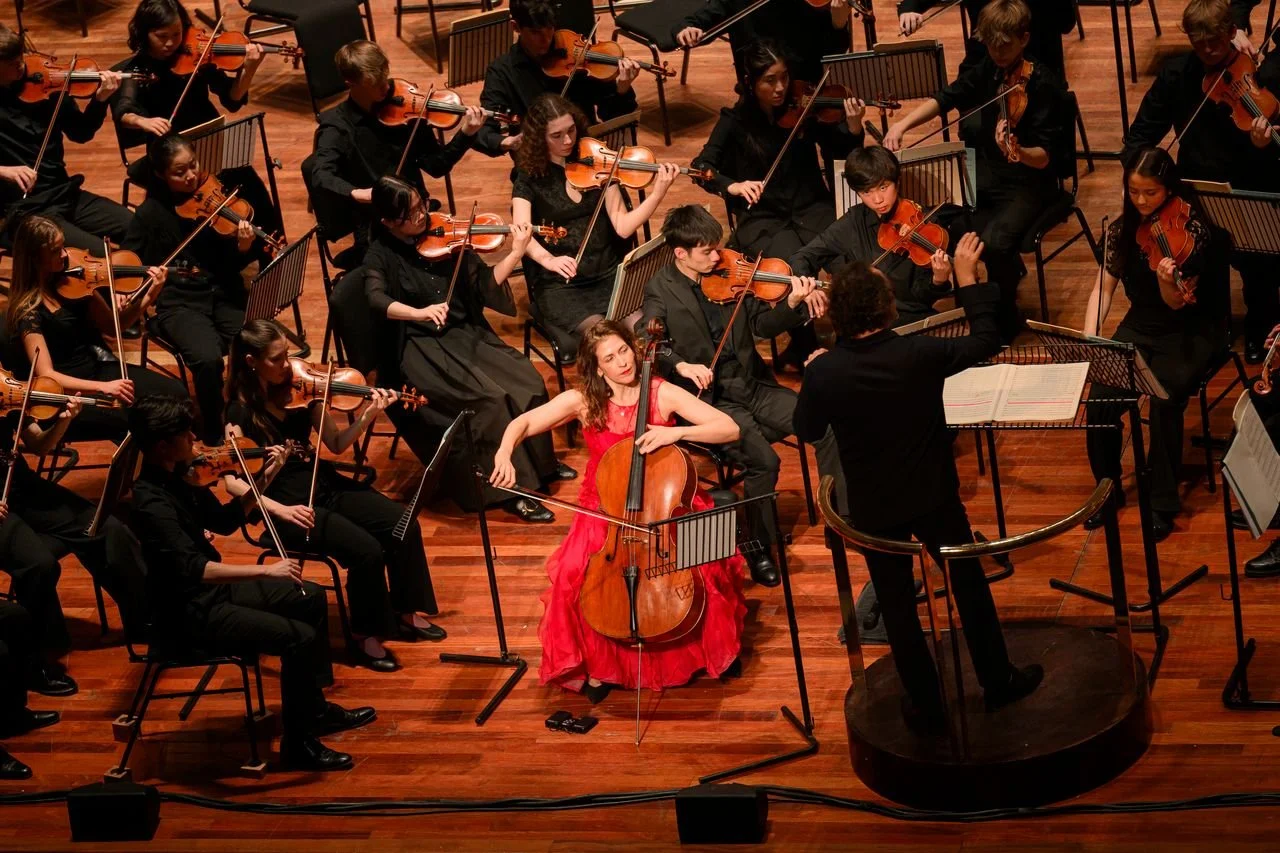
Photo credit: Tom Morley.
National Youth Orchestra. Royal Concert Hall, Nottingham, 06 January 2026,
⭐⭐⭐⭐⭐ Review by William Ruff.
“Music-making to gladden the heart and provide hope for the future.”
It has not been a good start to 2026 on the world stage. However, the spectacle of the National Youth Orchestra’s 160 astonishingly talented teenage musicians concentrated onto the Royal Concert Hall’s stage was one to gladden the heart and inject some much-needed confidence in the future.
They’ve called this year’s winter programme ‘Shimmer’, a great name for the four pieces they had already played in London and Warwick before bringing them to Nottingham. ‘Shimmer’ suggests light but the word does much more than that. Just say it aloud: it’s a word you can see, hear and touch. It conjures up light that is soft and tremulous: the sort of light that has drawn so many artists to the Mediterranean.
It's certainly a good word for evoking the Spain which French composers Debussy and Ravel evoked so powerfully in their music. Debussy’s Ibéria was an inspired opening choice for a huge orchestra of talented teenagers to perform. The composer wrote it for large forces, so involving 160 players just makes the colours brighter and the effects more vivid. Its opening section (‘In the Streets and Byways’) became a celebration of outdoor light and human activity, the NYO creating an astonishing panorama of colour and movement, the fruit of razor-sharp ensemble with each player contributing exactly the right shade and intensity of colour. Conductor Alexander Bloch coaxed from his young players sounds whose precision didn’t hinder spontaneity.
They followed this with City Scenes, written in 2006 by Karim Al-Zand, three musical, dance-like postcards from his home city of Houston, Texas. It’s music that captures the rhythms of life in all their diversity and draws on a multitude of musical languages: jazz, Latin, music from the Middle east and contemporary classical styles. It’s music which conjures up high-rise buildings, vast skies, shining glass as well as the private, mysterious world of a city at night. There’s lots of fine detail which the young players relished as much as the work’s thrilling ending in which the heartbeat of the city rang out with exhilarating intensity.
In the concert’s second half the NYO was joined by cellist Inbal Segev in DANCE by Anna Clyne, based on a 5-line poem by Rumi, a 13th century Persian poet and mystic. Each of its five movements corresponds to one of these evocative lines. ‘Shimmer’ is exactly the word that comes to mind as the work opens, beginning not with something loudly assertive but with something much more vulnerable, a sort of shimmering sincerity. Inbal Segev’s cello sang a poignant, searching melody which managed to suggest both personal experience and, at the same time, reached into the universal. After a sequence of intensely emotional movements the final ‘dance, when you’re perfectly free’ created a sense of warmth and joy with the cello singing serenely.
Finally came Ravel’s Rapsodie Espagnol. The NYO, under Alexandre Bloch’s sensitive direction, captured the nocturnal prelude of moonlit silhouettes, soft caresses and romantic sighs. In the following ‘Malaguena’ there were some vividly characterful trumpet calls and languorous piping from the cor anglais. The concluding ‘Feria’, rhythmically exuberant and vibrantly colourful, exploded with youthful energy and the joy of music-making. Our world became a warmer, more colourful, more tolerant place.
The National Youth Orchestra
Alexandre Bloch (conductor)
Inbal Segev (cello)