Nielsen’s Fourth Symphony, CBSO, Symphony Hall, Birmingham, Wednesday 08 October 2025, 4☆☆☆☆. Review: David Gray & Paul Gray.
Nielsen’s Fourth Symphony, CBSO, Symphony Hall, Birmingham, Wednesday 08 October 2025,
4☆☆☆☆. Review: David Gray & Paul Gray.
“A white-hot performance of Nielsen’s magnificent symphony.”
Adrian Sutton – War Horse Orchestral Suite
Adrian Sutton – Concerto for Violin and Orchestra
Nielsen – Symphony No.4, Op 29 (The Inextinguishable)
While writing it, Nielsen said that his 4th Symphony would ‘express what we understand by the spirit of life’. Similarly, ‘Life Force’ is the title of the final movement in Adrian Sutton’s Violin Concerto. So, in some ways, the programme of this concert invited us to consider how these two very different composers express the idea that life has some essential, unified, animating quality.
Sutton established his reputation as a composer writing music for the stage. His War Horse Orchestral Suite draws on incidental music he wrote for the celebrated play of that name. In this Suite one could hear his flair for creating orchestral textures which strongly evoke specific milieux and powerfully create atmosphere and mood. These qualities are essential when writing incidental music for the stage. However, while one could see how this music must be very impactful in a dramatic context, when placed on the concert platform, it seemed strangely lacking in theatrical flair, or compelling narrative flow.
Sutton’s Violin Concerto is a more convincing concert work, but not without its problems. Once again, one was struck by Sutton’s use of orchestral colour, and the piece seemed to play to the CBSO’s strengths in this respect: rich, sonorous string textures dominate; woodwind writing is characterful and eloquent. However, his melodic material in the opening movement, titled ‘Thermals’, seems ill-defined and sprawling, so the presence of any internal organising principle is not altogether clear.
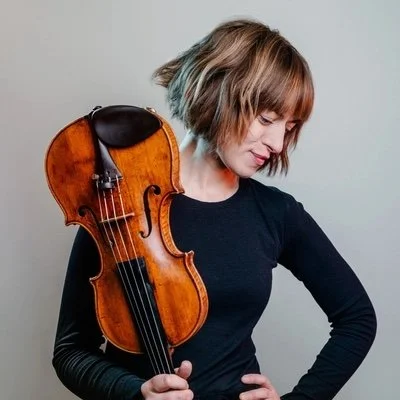
The following movements are more structurally integrated. Soloist, Fenella Humphreys spun long melodic lines with definition, purpose and emotional conviction in the second movement, ‘Far Cliffs’, and delivered scintillating virtuosity in the uplifting finale, ‘Life Force’.
Her folksong-based encore was deliciously delicate and perfectly complemented the melodic profile of the foregoing concerto.
Nielsen’s 4th Symphony is a quixotic and paradoxical work. If can feel monumental in terms of its sheer visceral force and monumental power. However, in truth, it is a seething, totally organic composition that never really settles. Conductor, Micheal Seal, marshalled his forces with authority and intelligence to give a compelling, well-structured argument from beginning to end.
Nielsen gives us imposing blocks of rather Brucknerian-sounding textures, but rather than standing alone, like monoliths, the conductor ensured that these textures slid and merged together like tectonic plates floating on a sea of red-hot magma. The orchestra played flawlessly with a real of unity of ensemble, shared understanding and scorching energy.
This was top-draw stuff. And when the light finally broke through at the end of the exhilarating final movement, it shone with an inextinguishable radiance.
Michael Seal – Conductor
Fenella Humphreys - Violin