Nottingham Chamber Music Festival 2026, Various Venues | 09-12 July 2026 ⭐⭐⭐⭐⭐ Review by William Ruff
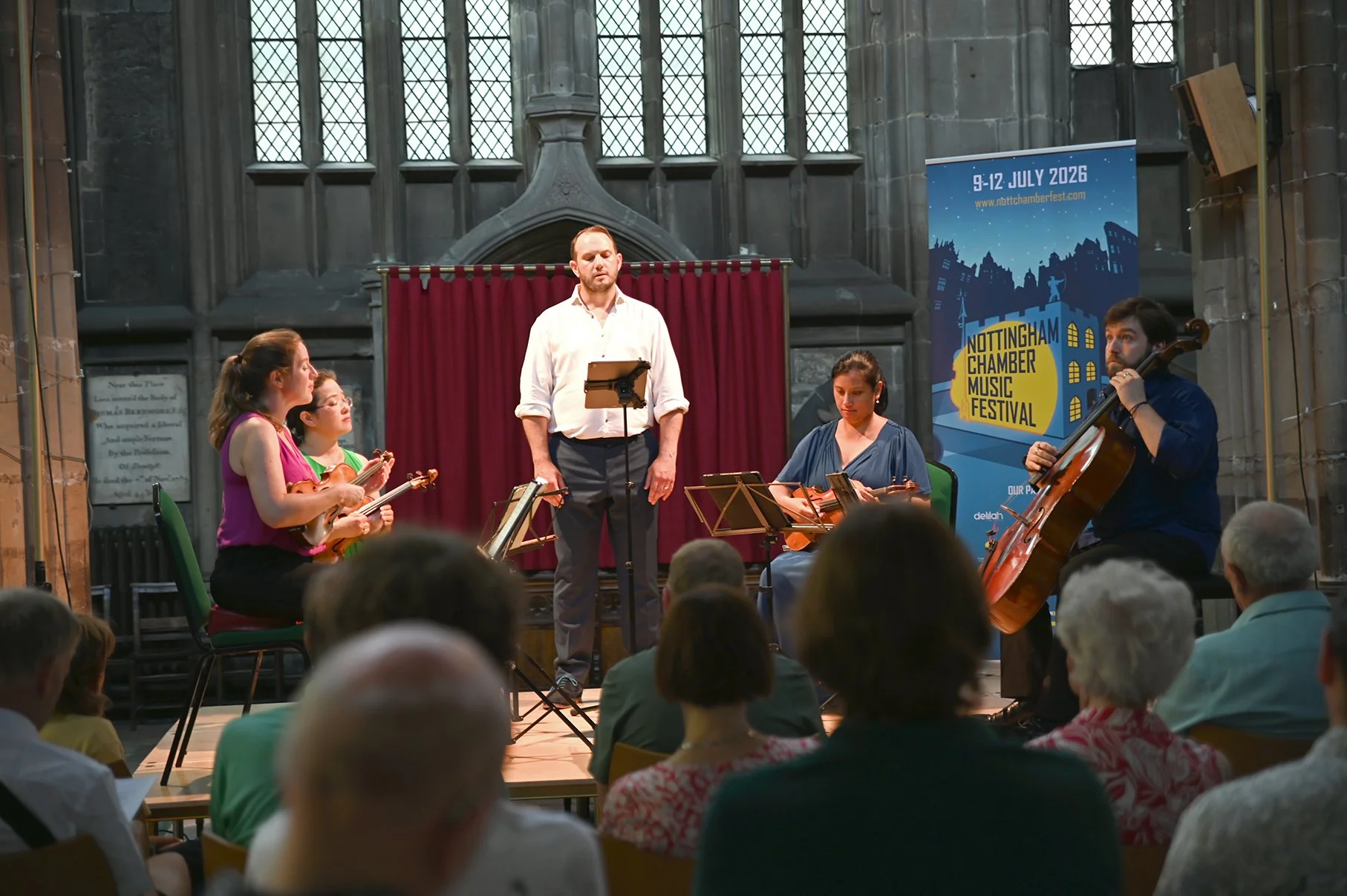
Photo credit: Saba Walton
Nottingham Chamber Music Festival 2026
Various Venues | 09-12 July 2026
Review by William Ruff
“A Festival for everyone: surprising, moving and entertaining young and old alike.”
If ever there is a musical event which refuses to rest on its laurels, it must be the Nottingham Chamber Music Festival. Founded in 2018 by Carmen Flores, the Festival continues to stretch boundaries and challenge expectations. You’ll still find the classical bedrock but there’s so much more: music dating from 300 years ago sits comfortably alongside music so new that the composer’s ink hasn’t had time to dry. World music rubs shoulders with folk and cutting-edge contemporary, whilst the target audience has now mushroomed to such an extent that the NCMF offers something for babies just weeks old, seasoned concert-goers in their nineties and every age group in between.
This year there was even more focus on how musicians relate to their listeners and on introducing new venues. The NCMF knows that the spaces where musicians perform play an essential role, offering not only widely varying acoustics but also atmosphere. This year St Mary’s in the Lace Market, St Peter’s in the city centre and the Nottingham Contemporary gallery hosted once again, as did Delilah’s Fine Foods and the Park Tunnel. Joining the list for the first time this year was The People’s Hall in Heathcoat Street, probably one of the most unusual settings any chamber music festival anywhere has ever chosen.
The scene was set by an introductory talk in the Central Library, entitled ‘So, what is chamber music anyway?’, a talk which dispelled a few myths and suggested that listeners shouldn’t think of it as grand and exclusive but rather just as ‘room music’, written for warm, comfortable human spaces where listeners can eavesdrop on intimate musical conversations, where listening becomes visible as audiences see players breathe, smile, and adjust their responses to the music. There is something very special about sharing the same physical space as the performers, breathing air that has been set vibrating by musical instruments.
In their St Mary’s concert the Villiers Quartet put the theory brilliantly into practice. They played the first of the string quartets which Beethoven wrote in 1805 for Count Andrey Razumovsky, Russian ambassador to Vienna. Beethoven wrote music of unprecedented complexity for a famous musical connoisseur and the virtuoso musicians whom he funded. However, the Villiers Quartet, in their exemplary performance, conveyed how entertaining theatrical the music is, how much like a conversation – and just how playful Beethoven’s ideas are as they are passed from one instrument to another, as surprises tumble out in quick succession. In this VQ performance was distilled the essence of chamber music – and the audience loved it, cheering loudly at the end and eager to tell the musicians how thrilling it had been to hear and see such an involving performance.
However, there was more to this concert than the outstanding ‘Razumovsky’ quartet. In the concert’s first half the VQ played Valencia by the contemporary American composer Caroline Shaw. Like all her music, what strikes you is the extraordinary musical texture: its oscillating string harmonics contrasting with the pizzicato cello line. Its billowing surfaces create a sense of wonder in something we might otherwise take for granted, in this case the humble Valencia orange. Shaw’s extremely different song-cycle By and By also featured in the same concert. The baritone Marcus Farnsworth joined the quartet to sing four songs which reimagine the American hymn tradition and are intense meditations on death and what might lie beyond. The instruments were often treated in unusual ways: knuckles knocking on wood; strange, fluttering harmonics suggesting angel wings: they all added to an intensely dramatic experience. Whether as a singer of song and opera or as a conductor, Marcus Farnsworth is a compelling musical story-teller. It’s hard to think of a more convincing advocate of this music.
Delilah’s Fine Foods provided not only wine and canapés but also a welcoming upstairs performance space. The Aquilae Duo (Lisa Nelsen, flute, and Eleanor Turner (harp) performed just feet away from the audience, the proximity creating a warmly informal atmosphere, almost like a family gathering at home – except for the virtuosity of the two musicians. They delighted their listeners with music both familiar (the slow movement from Mozart’s Flute and Harp Concerto, arrangements of three of Vaughan Williams’ Songsof Travel)and unfamiliar (including the recent Sonata by Welsh composer Mared Emlyn and arrangements of Kate Bush and Irish folk tunes). It was all beautifully played and suited the surroundings perfectly.
The 0-7 age group wasn’t forgotten. In St Peter’s, in an event staged jointly by NCMF and the church’s own Coffee Break Concert series, BabyGigs presented The Great Shuffle Show, an entertaining, high-energy music-meets-puppets event in which the children themselves choose the playing card that will reveal the next scenario and puppet. Terry the shopping trolley was a great favourite along with various birds and animals. The children were kept fully involved, having so much fun that they probably didn’t realise just how much they were learning about musical instruments and composers. You could see lots of wide-eyed wonder amongst the children in the audience – and for some this may have been the start of a lifelong journey of musical exploration.
Young people were also at the centre of music performed throughout Saturday afternoon at the Contemporary Gallery by winners of the Nottingham Young Musician competition. James Burton performed songs by Fauré, Gurney, Bellini and Schumann whilst percussionist Seb Hope performed pieces by Herbie Hancock (amongst others) and soprano Evie Holder performed music by Schubert, Mozart and Roger Quilter. Judging from the performances I was able to sample, the future of the city’s music is in very capable hands indeed. Three cheers for both Nottingham’s Young Musician competition and its Chamber Music Festival for showcasing such talent.
It certainly takes imagination to see Nottingham’s People’s Hall as a venue for chamber music. Situated in Heathcoat Street, it was built 275 years ago and has been, at various times, a grand, private Georgian townhouse, the city’s School of Design and an educational and temperance centre for the working people of Nottingham. Saturday’s concert was preceded by an introductory talk, outlining the building’s past as well as a future after extensive restoration occurs. Then a tour took the audience into some of its untouched Georgian interiors to see the decorative plasterwork and magnificent Cuban mahogany staircase.
The concert itself took place in the large lantern room at the top of the People’s Hall. Its paint may have been peeling and its need for lots of TLC may have been extreme – but it was an excitingly apt space for the solo violin playing of Darragh Morgan, a specialist in performing cutting-edge contemporary classical music (and much else besides). The bareness of the room and all its hard edges made the acoustics perfect for a solo instrument. Darragh Morgan’s virtuosity brought to life two Fantasias by the early 18th century compose Telemann as well as much music written in the 21st century. Linda Buckley’s Exploding Stars is a shimmering, ethereal composition which explores the divide between acoustic and electronic music. Donnacha Dennehy’s Overstrung is another piece for solo violin and electronic soundtrack, technically very complex but played with great coolness and beauty by Darragh. Another highlight was the concluding piece Knee Play 2 from Einstein on theBeach by Philip Glass, a mesmeric piece built on incremental repetition and shifting rhythmic patterns: its effect hypnotic and trance-like.
The final event of this year’s Festival took place (as it did last year) in the Park Tunnel. I sat in the same seat as last time, hoping that the Tunnel would work its wondrous acoustic magic again. And it did. It’s not just that you can hear every nuance of the music. It’s as if the detail flies in from multiple directions, along the walls and floor, across the roof, through the air connecting players and audience. The six Festival Musicians who played Vivaldi’s Four Seasons did so with energy, virtuosity and a sensitive appreciation of the imagery used in the sonnets which the composer wrote to accompany his four concertos. The opening of ‘Winter’ produced a chilling effect in the Tunnel’s special sound world: the thin, eerie tone of the strings, mimicking the bite of the wind has surely never penetrated an audience’s ears with such compelling vividness.
This 2026 Festival has been another triumph of imaginative programming, impeccable organisation and remarkable inclusiveness. You perhaps wouldn’t have thought that a celebration of chamber music could appeal to all tastes and to all ages. Well, Nottingham’s does – and if you want to know how it does so to such a high standard, you need look no further than the Festival’s inspirational Director, Carmen Flores.
Nottingham Chamber Music Festival 2026
Festival Talk: ‘So, what is chamber music anyway?’ – Carmen Flores and William Ruff
Music and Wine at Delilah’s Fine Foods: Lisa Nelsen (flute) and Eleanor Turner (harp)
Villiers Quartet (Katie Stillman, Tamaki Higashi, Carmen Flores and Toby White) with Marcus Farnsworth (baritone)
The Great Shuffle Show performed by BabyGigs (Eleanor Hodgkinson, Simon Chalk and Ricardo Insua-Cao)
Nottingham Young Musicians Showcase: Evie Holder, James Burton, Seb Hope (with Peter Davis, Adam Shortall, Willem Knights, Hugo Sasai and Grace Liu)
The People’s Hall: Music for Violin played by Darragh Morgan
Four Seasons: Festival Musicians (Darragh Morgan, Sophie Rosa, Jenny Sacha, Rose Redgrave, Tim Smedley, Petra Hajduchova)