Quatuor Agate. Lakeside, Nottingham, 27 November 2025, 5☆☆☆☆☆. Review: William Ruff.
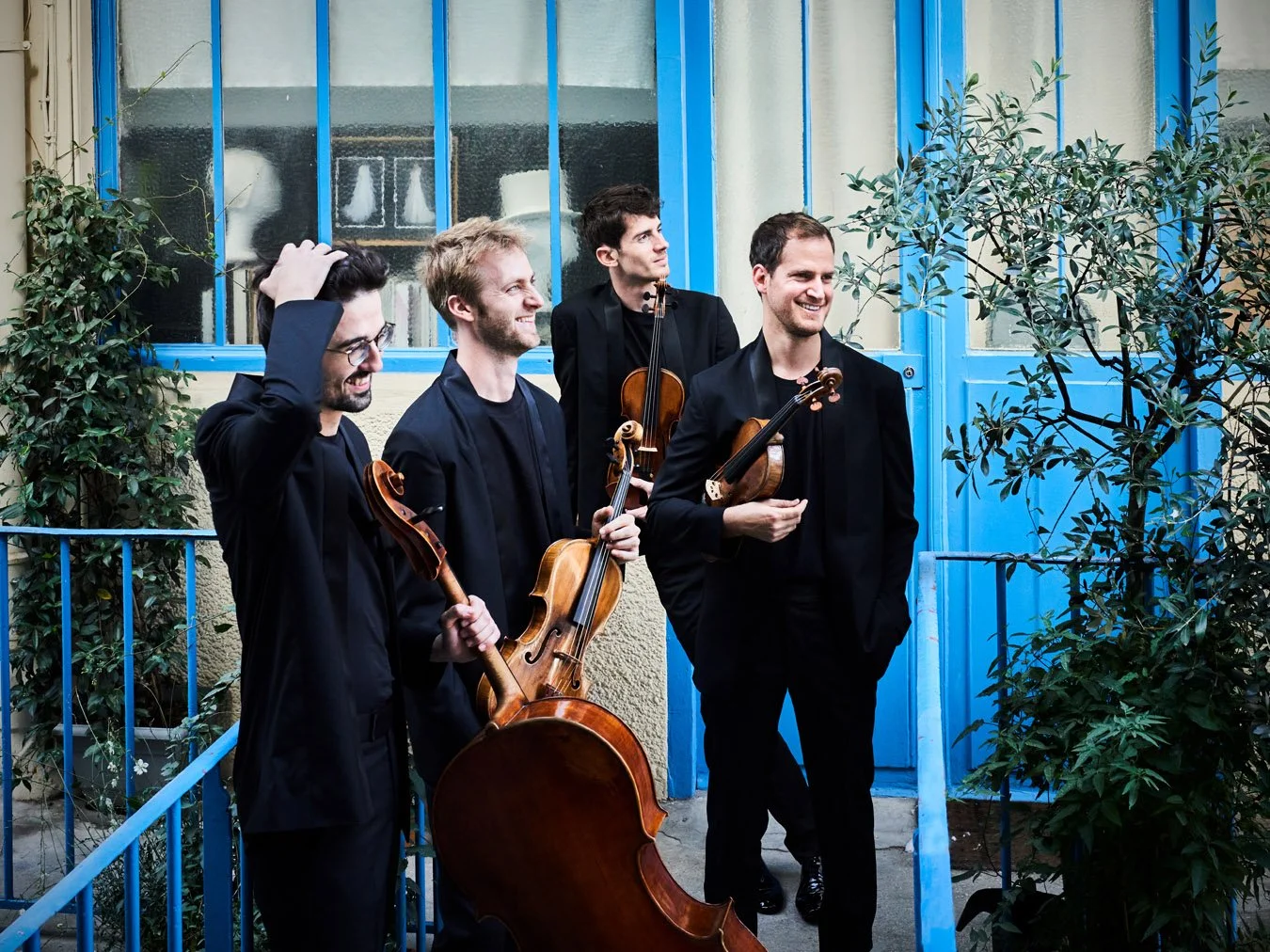
Photo Credit: Lakeside.
Quatuor Agate. Lakeside, Nottingham, 27 November 2025, 5☆☆☆☆☆.
Review: William Ruff.
“Quatuor Agate reach deep inside the music with playing of probing intensity.”
One of the benefits of having one of the best recital halls in the UK is that Lakeside attracts a seemingly inexhaustible supply of dynamic, award-winning chamber ensembles. Thursday night’s concert was no exception, the most recent visitors being the Quatuor Agate. When they chose their name, I hope they offered a very large bottle of champagne to anyone who could explain why. Apparently the name is inspired by the woman who was once muse to the composer Johannes Brahms, but who disappeared from his life when he had to admit that he was one of nature’s bachelors. Quatuor Agate certainly have an eye for fine detail.
Their concert included a rarity: the String Quartet No 1 by Erich Korngold, a composer who is perhaps best-known for the music he wrote for swashbuckling Warner Brothers films such as The Adventures of Robin Hood and The Sea Hawk in the 1930s and 40s. This was after he to escaped Berlin; being Jewish, he and his family found it impossible to remain. In earlier and happier times, however, his German life could hardly have been more promising, being hailed as the greatest child prodigy since Mendelssohn.
The first of his three pieces for string quartet was written in the early 1920s, its sound-world a long way from the lush melodies he later composed for Hollywood. Its sonic colours are bold, bright and glowing; the piece is full of emotional and psychological intensity; its lines are sharp and jagged and the whole thing pulsates with life. Quatuor Agate was deeply inside this music, shading instinctively between the spiky and the sensuous, clearly relishing the jagged rhythms and charging Korngold’s ideas with an immediacy both exhilarating and edgy.
The other two works on the programme were much more familiar. Mozart wrote the first of his so-called ‘Prussian’ string quartets in 1789 for the King of Prussia, tactfully ensuring that the cello (the King’s own instrument) had a starrier role than usual. He certainly did the King proud, giving the cello plenty of memorable passages and providing His Majesty with plenty of technically difficult music to get his teeth into. Quatuor Agate had an irresistible sweep to their performance, their sound full and generous yet at the same time spiced with intricate detail and delightful phrasing. They were spirited in the outer movements, adopted just the right degree of tenderness in the slow movement and were lithe and lively in the Minuet.
Quatuor Agate ended their Lakeside concert with Beethoven, the last of his Razumovsky Quartets. Razumovsky was the Russian Ambassador in Vienna (as well as being a keen violinist) who requested Beethoven to write him some quartets that included Russian melodies. The set Beethoven devised broke the mould of what people at the time expected of a string quartet and his first audiences must have found them challenging. Quatuor Agate relished the energy of the buoyant opening movement whilst also being alive to its complexity and dramatic tension. The second movement was a serene centre of great beauty whilst the finale erupted with explosive energy, ending with a brilliant, triumphant coda. In fact, it was the way in which the players brought to life Beethoven’s extreme emotional range - the frenetic and the tranquil - that injected so much drama into their performance. As in the rest of their programme, they reached deep within the music, their playing intense, probing and rhythmically exhilarating.
Quatuor Agate
Adrien Jurkovic (Violin), Juliette Beauchamp (Violin), Raphaël Pagnon ( Viola), Simon Iachemet (Cello).