Southwell Music Festival 2025. Southwell Minster and other venues, 22-25 August 2025, 5☆☆☆☆☆. Review: William Ruff.
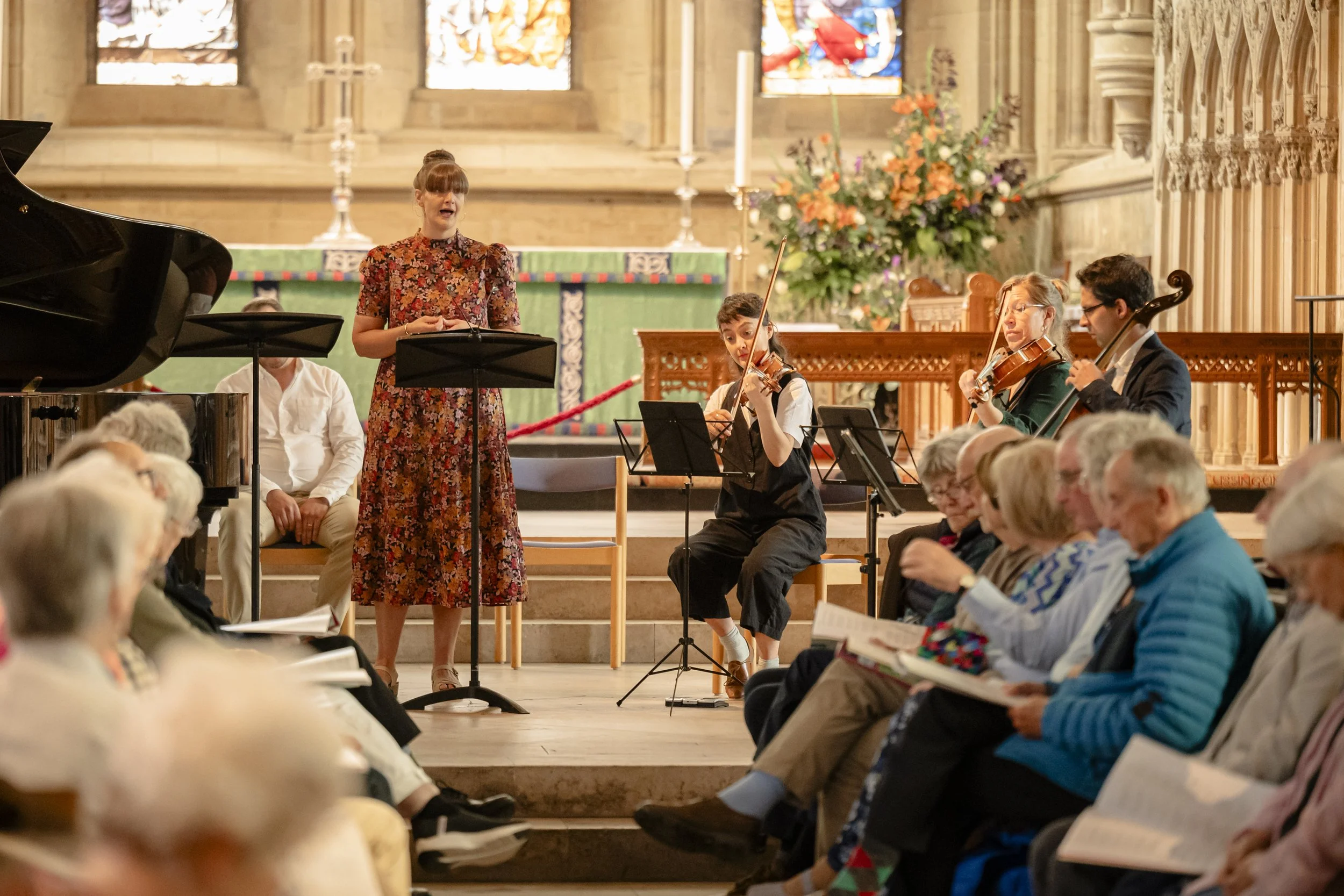
Photo credit: Tom Platinum Morley.
Southwell Music Festival 2025. Southwell Minster and other venues, 22-25 August 2025,
5☆☆☆☆☆. Review: William Ruff.
“Southwell: a Festival that brings ‘the best live music to the heart of Nottinghamshire.”
The Southwell Music Festival has just celebrated its 11th anniversary. Now, this may not be the sort of number you normally make a fuss about, but the Southwell Festival has become such a prominent feature on the county’s musical landscape, that it feels as if it’s been around for much longer.
With 26 events on the programme this year, it’s (in some ways) difficult to know where to begin a review, especially when one can’t sample them all. However, you could start anywhere, for one very good reason. Despite the extraordinary diversity of what has been on offer, the heart of the Festival beats in every single event. At Southwell it’s never a case simply of lumping things together, ticking the boxes and hoping for the best. No, this Festival is driven by a refreshingly single-minded purpose.
You have only to read Festival Director Marcus Farnsworth’s ‘Welcome’ in the programme book. He writes about talent, energy and commitment, brought together by a Festival which offers audiences the chance to experience the best possible live music in the beautiful surroundings of Southwell Minster and elsewhere in the town. However, the Festival is clearly about much more than the music. At its heart is the idea of community, of sharing great music with others, of encouraging curiosity and open minds. More than anything it makes us listen to each other, to leave our world of phones, social media and artificial intelligence and ‘to tune our ears to the thoughts and ideas of others.’
With such a sharp focus, it doesn’t really matter that my Festival experience started with an hour-long recital called ‘Love, War and Nature: Mahler and the Folksong’. I wasn’t alone in having very little idea what to expect and what the effect would be of mixing some of Mahler’s Des Knaben Wunderhorn settings with new arrangements of English folksongs, such as Polly Oliver and Waly, Waly. Almost immediately, however, everyone seemed to realise that something special was happening, as connections started to be made between pieces never connected before.
Just take the first two songs. Marcus Farnsworth started by singing Mahler’s Where the splendid trumpets sound, the story of a girl who is visited by her lover on the eve of battle. The story is chillingly ambiguous: is the lover already dead or does he simply know that he’s going to die the following day? Marcus is a remarkable musical story-teller, his performance conveying both the rapt tenderness of the encounter and its almost unbearable sense of foreboding. Libby Burgess’s piano playing was an integral part of the drama in creating off-stage military fanfares and drum beats. The idea of young love crushed by military duty became intensely moving.
This was immediately followed by a brilliant new arrangement of Polly Oliver, the story of a young woman who misses her soldier-lover so much that she disguises herself as a man and enlists in the army herself to follow him. It’s a song which poignantly contrasts with the Mahler, each setting illuminating the other with their themes of love and devotion. Judy Louie Brown was the folksong singer, as attentive to the words as she was to making the notes shine. She was accompanied by Gemma Bass (violin), Lena Eckels (viola) and Nathaniel Boyd (cello). Gemma Bass’s arrangements were an integral part of the recital’s success: imaginative, achingly poignant and beautifully performed. The fact that so many audience members were asking at the end if they could buy a recording of Gemma’s arrangements speaks for itself. They deserve to be widely heard and enjoyed.
The event which followed was very different on the surface, although the ideals which underlay it indicated the same musical DNA. This was the Chetham’s Alumni Vocal Showcase, one of several Festival Fringe concerts. The famous Manchester music school was represented by five recent students: Scarlett Banks (soprano), Divine Simbanegavi (mezzo), Isaac Bentley (tenor) and Harry Priestly (baritone), accompanied by the multi-talented Theo Geileskey (piano). This concert (in Southwell Methodist Church) not only gave five young students a wonderful opportunity to perform in front of a discerning audience but also raised funds for this year’s Fringe charity: Reach Southwell Learning Disability. The young musicians didn’t only play and sing expertly but they also proved to be accomplished programmers and presenters. Solo songs were mixed with operatic arias and ensembles: lots of Mozart but also Schubert, Richard Strauss, Debussy and Schumann. They created a welcoming, informal atmosphere, whilst never stinting on musical insight.
Later the same day came the Festival Cabaret in Southwell Library, performed by Festival Voices and pianist Libby Burgess. This mixed close harmony numbers with solo songs and covered a huge range: the Beatles, Simon and Garfunkel, Stephen Sondheim, Flanders and Swann and much else besides. The singing, both in ensemble or solo, matched fine voices with sharp comic timing. Some of it was very poignant too and the transitions between happy and sad were handled with aplomb. The final sequence included Climb Every Mountain, Queen’s Lazy Afternoon and Johnny Mercer/Hoagy Carmichael’s Skylark, before ending with Victoria Wood’s very cheeky Let’s Do It.
The Festival reached its climax with this year’s Gala Concert, Bach’s Mass in B Minor. This may be one of the cornerstones of western culture, but its complexities, even for those who know the work well, benefit from being unravelled. Libby Burgess was on hand to give another of her illuminating pre-concert talks, placing the work within its musical and historical context, highlighting its operatic and dance-like qualities and explaining Bach’s genius for gauging the emotional effects of adventurous harmony and dramatic pacing.
All this ensured that ears and eyes were fully open when it came to the performance. Marcus Farnsworth was the conductor, in front of whom were arrayed the handpicked Festival Baroque Sinfonia and Festival Voices, a choir of 21 of the UK’s top singers. The fact that 9 of them sung the notoriously difficult solos gives some idea of the ensemble’s in-depth quality. The Mass’s emotional and technical range is vast, with Bach demanding nothing less than virtuosity and absolute commitment from his performers. It’s a piece which needs transparent textures, razor-sharp accuracy and total commitment of mind and body. This opening moments of this performance revealed the central strength of this B Minor Mass: the total immersion of each musician. Whether it was in the intense counterpoint of the second Kyrie or the outbursts of cosmic joy at the start of the Gloria and Sanctus – or the intimate and deeply moving Agnus Dei – Marcus Farnsworth and his musicians had the measure of this mighty work. The relatively small scale of his forces made them light on their feet, making the dance-like movements particularly exhilarating. Instrumental and vocal solos were handled with brilliance and the whole ensemble combined agility and unanimity to thrill and move in equal measure.
Amid all this music was an event in which Kadiatu Kanneh-Mason was interviewed by Marcus Farnsworth in the Minster’s Great Chamber. This was a proper conversation, clearly spontaneous and full of the wisdom born of deep experience. Of course, it is always interesting to get insights into the lives of the UK’s most musical family, but the interview was so much more than a glimpse behind the scenes at the seven Kanneh-Mason siblings’ domestic and musical routines. Their extraordinary talent has been much celebrated, of course, but it was disturbing to hear of racial prejudice and the stresses caused by an era dominated by social media. Much of what Kadiatu (and Marcus) had to say focused on the disappearance of music from the curriculum in many state schools, something which she has seen deteriorate in the 13 years which separate the oldest and youngest Kanneh-Mason sibling. Classical music is fast becoming the exclusive privilege of those whose parents have the money to send them to independent schools.
No one listening to Marcus and Kadiatu in conversation would have disagreed that everyone has the right to a musical education (both as performers and as listeners) -or that there is a need for louder voices to be raised on this issue. The Southwell Music Festival has music’s universality at its centre and is an eloquent advocate of its power to communicate at the deepest level and so bring people together.
This has been just a very limited snapshot of what this year’s Festival has had to offer. All those who attended will have enjoyed their own individual Festival, perhaps choosing the jazz, the musical picnic, Kathryn Tickell’s folk music, instrumental and vocal recitals, the Minster services, the come-and-sing performance…and many other things which will have moved and thrilled them. If you missed this year’s Festival, there’s always next year. Just remember: when the starting pistol is fired for the race to the box office, you need to be quick off the mark.