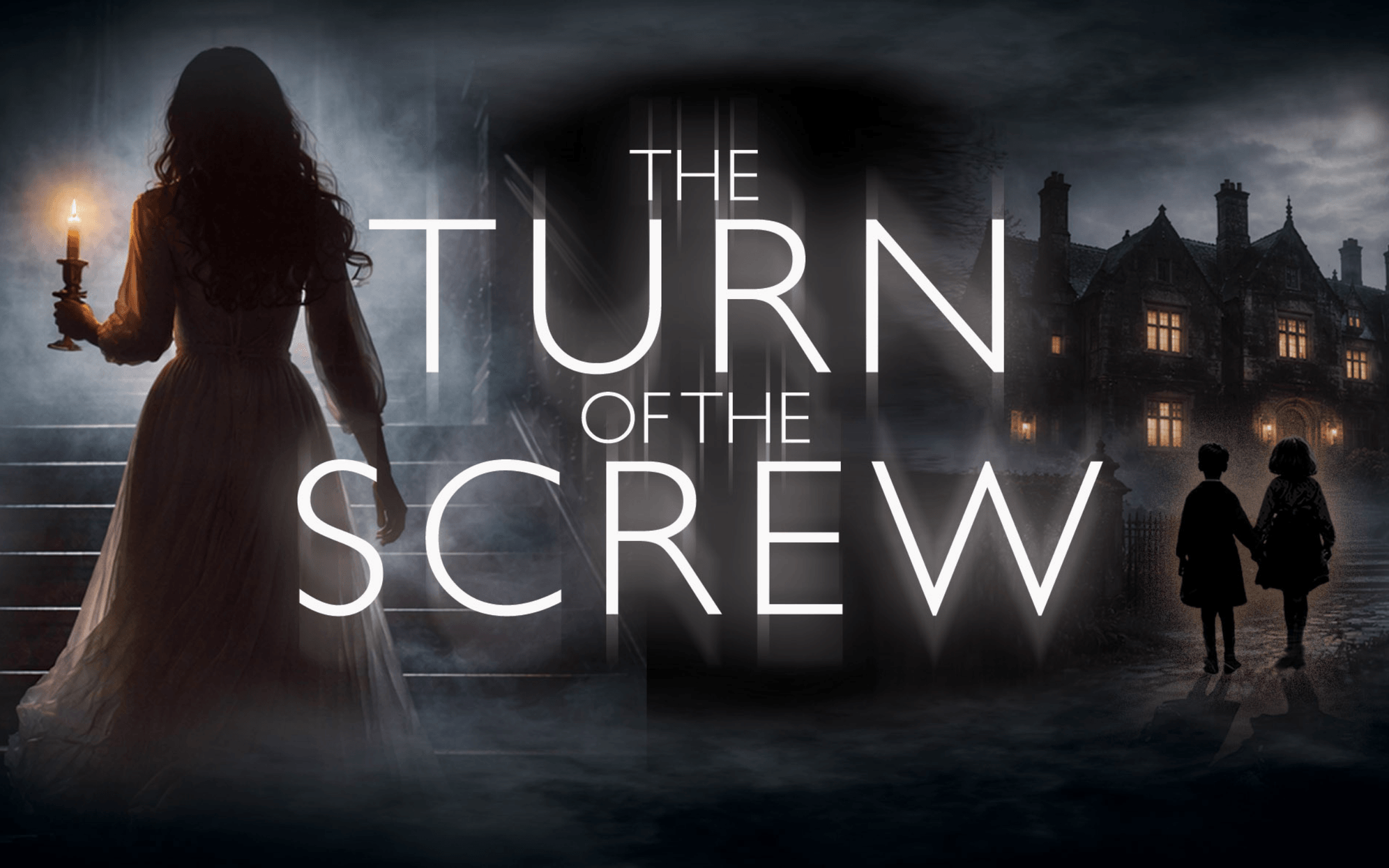
The Turn of the Screw
Blackeyed Theatre and Arcola Theatre, the Studio, the Rep, Birmingham | 29 – 31 October
⭐⭐⭐ Review by David Gray & Paul Gray
“The cast do sterling work.”
Writer, Morgan Lloyd Malcolm has created an intelligent, if wordy adaptation of The Turn of the Screw. It deals with a lot of ideas: the nature of reality, the reliability of memory, the psychology of the irrational. And while this is interesting, there is a danger that the script’s cleverness, along with some structural issues, undermines the story and prevents it from being that scary, which is, surely, the point of the Henry James Novella.
The clue to the story’s impact lies in the title. The turning of the screw describes the gradual ratcheting up of tension as the Governess grows in her conviction that the children in her care are being haunted. Terror mounts as the ghosts circle ever closer, becoming increasingly brazen, and as we begin to glimpse their depravity.
The production starts with a sudden black out and a random deafening scream. The Governess is on stage in a febrile state of heightened emotion, trying to convince us and herself that what we see is true. Dry ice washes the stage and a gothic manor house looms in the background. It is all a bit overwrought and leaves the play with nowhere to go. The screw has already been turned.
The play’s central device is a dialogue between the Governess and a ‘man.’ The purpose and identity of the man is never made clear. He interrogates the Governess about the events of the story, thereby providing a reason for narrative exposition. However, he is cynical and doubtful of the story she tells, constantly questioning it and casting her as an unreliable narrator.
The problem here is that we are never provided with a stable reality, away from which the events of the play can move into uncertainty and instability. Again, the screw is already tight in its groove almost as soon as we have started.
So, while the story telling fails to deliver the requisite crescendo of dread, it is left to a few more sudden blackouts and deafening screams to deliver a facsimile of horror.
The cast do sterling work. Amy Tara, as the Governess, maintains an impressive state of supressed hysteria throughout the play. Toby Benyon and Kathleen McAuley Irvine, doubling as the children and the ghosts, switch artfully between innocence and outright creepiness. Jim Fish, as the Man, manages his complex dialogue with aplomb. Katy slater is an equivocal and inscrutable Mrs Grose.
Nicky Allpress well directs the production very well indeed. And one seldom sees lighting carry so much of the story telling so effectively: excellent work from Oliver McNally.
But at the end, the moment of crisis in the denouement is mundanely physical, leaving little room for ambiguity regarding the psychological and the supernatural. This is an adaptation that sets out to do something new with the story, which is always laudable. But one is left not quite sure of what it is setting out to do.
Cast
Toby Beynon – Miles/Quint
Jim Fish – Man/Master
Kathleen McAuley Irvine – Flora/Jessel
Janita Mikkola – Ensemble
Katy Slater – Mrs Grose
Amy Tara – Governess
Creatives
Morgan Lloyd Malcolm – Writer
Nicky Allpress – Director
Matthew Cassar – Set and Costumes
Oliver McNally – Lighting
Sound – Hattie North
Illusionist – Wayne Fox