The Flying Dutchman, Wagner, WNO, Birmingham Hippodrome | 07 May 2026 ⭐️⭐️⭐️⭐️⭐️ Review by David Gray & Paul Gray
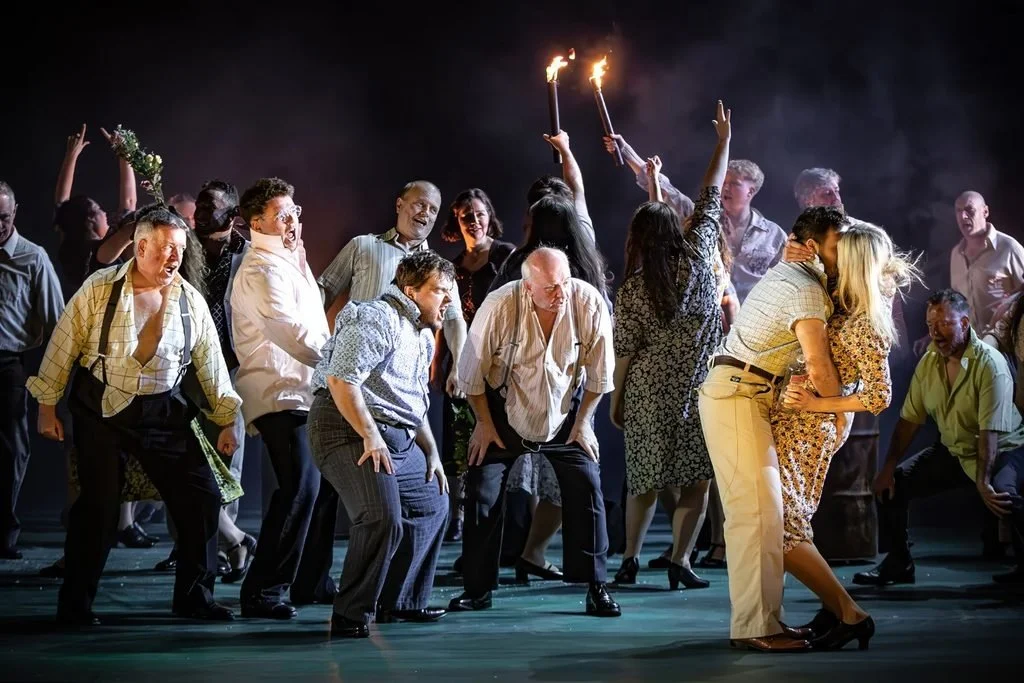
Photo credit: Craig Fuller
The Flying Dutchman
Wagner, WNO, Birmingham Hippodrome | 07 May 2026
⭐️⭐️⭐️⭐️⭐️ Review by David Gray & Paul Gray
“A spare but unsparingly intense production.”
This is a very spare production which seems to embody many of Polish theorist Grotowski’s ‘Poor Theatre’ concepts. It is stripped down to the essential elements: a single backcloth that raises or lowers to reveal symbolic tableaux, a largely empty stage, simple lighting effects, and a heavy use of symbolism. The focus is very much on the actors and the music. Oh - and enormous amounts of dry ice.
The production is brooding, atmospheric and at times quite disturbing. At first glance Director, Jack Furness seems to deliver quite a static concept. Figures stand and deliver on a huge, mostly bare stage. But the overall impression is not of stasis, but one of stillness. The lack of dramatic clutter gives the performers room to explore their internal reality to fullness. The action is never at a standstill; emotional momentum is constant.
And the bare stage is never truly empty; it seems to act as a vacuum that sucks the music up from the pit, so that it surrounds the characters more spectacularly and eloquently than any set ever could.
The singing is, without exception, staggeringly good, and the diction truly outstanding. But what makes this particular cast so very excellent is how integrated their vocal and dramatic performances are. There is no boundary between singing and acting; they are all true ‘singing actors’ whose characterisations are informed by every aspect of the text and music.
Rachel Nicholls delivers an intriguing and complex Senta. Vocally, her casting is perfect. She has all the weight, power and stamina to manage this demanding part. Yet she also has a freshness and the ability to convincingly express innocence and naivety. Her Senta is troubled, haunted, but compassionate. And her compassion for Erik proves to be her undoing – ie. when the Dutchman mistakes this compassion for love.
As The Dutchman, Simon Bailey totally embodies this agonizingly tortured character. He sings with incisive power and exemplary diction. Every word carries weight and impact. The rest of the cast are everything they should be; utterly superb. Special mention must also go to deep-bass James Creswell as Daland; his was vocal and dramatic artistry at its most consummate.
Furness’ use of the chorus is clever. At the start of Act 3, rather than the womenfolk bringing the menfolk food and drink, we have an uncouth, bawdy knees-up. It is a riot of drunken & highly sexualised activity. Then, when it is time for the (usually off-stage) male chorus of ghostly sailors to interject, Furness has them take possession of the onstage live sailors, who sing the part. It is a moment which embodies the director’s treatment of the supernatural throughout the opera; Furness grounds everything in the human experience, so that there is no real need for stage spectacle.
The chorus are excellent in this scene, as they are throughout, singing and acting with total commitment. Conductor, Tomáš Hanus drives the musical narrative with passion and intelligence. The orchestra play with tight ensemble and great attention to detail.
This show is a brilliant example of how much can be done with so little, as long as you have performers who can really deliver the goods – and, my word, they certainly can: simply superb.
Cast
The Dutchman – Simon Bailey
Senta – Rachel Nicholls
Erik – Leonardo Caimi
Mary - Moniker Sawa
Daland – James Creswell
The Steersman - Trystan Llŷr Griffiths
Senta’s Mother – Rhiannon Llewellyn
Nurse – Stacey Wheeler
Young Senta – Theodora Davies, Phoebe Turner
Creatives
Conductor - Tomáš Hanus
Director – Jack Furness
Designer – Elin Steele
Lighting – Lizzie Powell